Radon system inspection and repair
A radon system inspection is a methodical look at a system that already exists: the gauge, the fan, the pipe, the seals at the floor, the outlet outdoors and the paperwork. It is most useful when you have bought a house with a system you know nothing about, when the gauge has moved, or when a test has come back higher than expected. Many faults can be repaired without rebuilding the system, and a fresh test of the air shows what the repair achieved.
Request a quote
Tell us about your home. We reply by email with the next step. No obligation.
Prefer email? contact@calgaryradonpro.ca
What does a radon system inspection cover?
Every part between the floor and the outlet, plus the records. The aim is to learn whether the system still does the job it was built for, and if it does not, to find out why.
| Part of the system | What is examined | What a problem looks like |
|---|---|---|
| Manometer | The two liquid levels against any start-up reading on record, and the small tube at both ends. | Columns level, liquid low, a loose tube, or no start-up reading to compare with. |
| Fan | Sound, vibration, direction of flow and the couplings on either side. | Grinding or humming, a cracked coupling, or a housing that holds water. |
| Power supply | How the fan is fed and whether it can be switched off by accident. | An outlet shared with other equipment, or a switch nobody has labelled. |
| Pipe | Joints, supports and slope along the whole run. | Joints never glued, sagging sections, or a low spot where water collects. |
| Suction point | The seal where the pipe meets the slab, the sump lid or the membrane. | Gaps, dried-out sealant, or a lid that was lifted and never resealed. |
| Floor and walls | Cracks, the joint between floor and wall, drains and any new openings. | Openings made since installation, such as a trench cut for plumbing. |
| Discharge | Where the outlet ends and what now surrounds it. | A blockage, ice staining, damage, or an outlet that has been boxed in. |
| Combustion appliances | Whether the furnace, water heater or fireplace drafts normally with the fan running. | Signs of flue gas spilling at a draft hood. |
| Label and records | The system label, the installer named on it and the test reports from before and after. | No label, no report and no start-up reading. |
One limit should be stated early. An inspection examines equipment. It is not a measurement of the air. A system can pass every line of the table and the house can still need a test, which is why a thorough inspection should end with a plan for one.
When is an inspection worth booking?
When something has changed, or when something is unknown. A system that holds its gauge reading and has a recent long-term result on file is not made better by a visit booked only because the calendar has moved on.
- You have bought or inherited a house with a system and there is no paperwork.
- The manometer has drifted away from the reading recorded at start-up.
- A long-term test or a monitor shows more radon than the last result on record.
- The basement has been developed, the slab has been cut, or the sump pump has been serviced.
- Gurgling or dripping can be heard inside the pipe.
- The fan or part of the pipe sits outdoors or in an unheated attic, and winter performance is in doubt.
A fan that has gone silent is a narrower problem with a page of its own. See how a failed radon fan is diagnosed and replaced.
I bought a house that already has a radon system. Where do I start?
Start with the paper, then the gauge, then a test of your own. A system on the wall tells you that somebody once decided to reduce radon in this house. It does not tell you what the level is today.
Ask the seller or the realtor for the installation invoice, the name of the installer and the reports from before and after the work. Look for a label on the pipe. It should name who built the system and when. If the paperwork gives a certification number, C-NRPP runs a certification check that confirms an individual's certification from that numbersource.
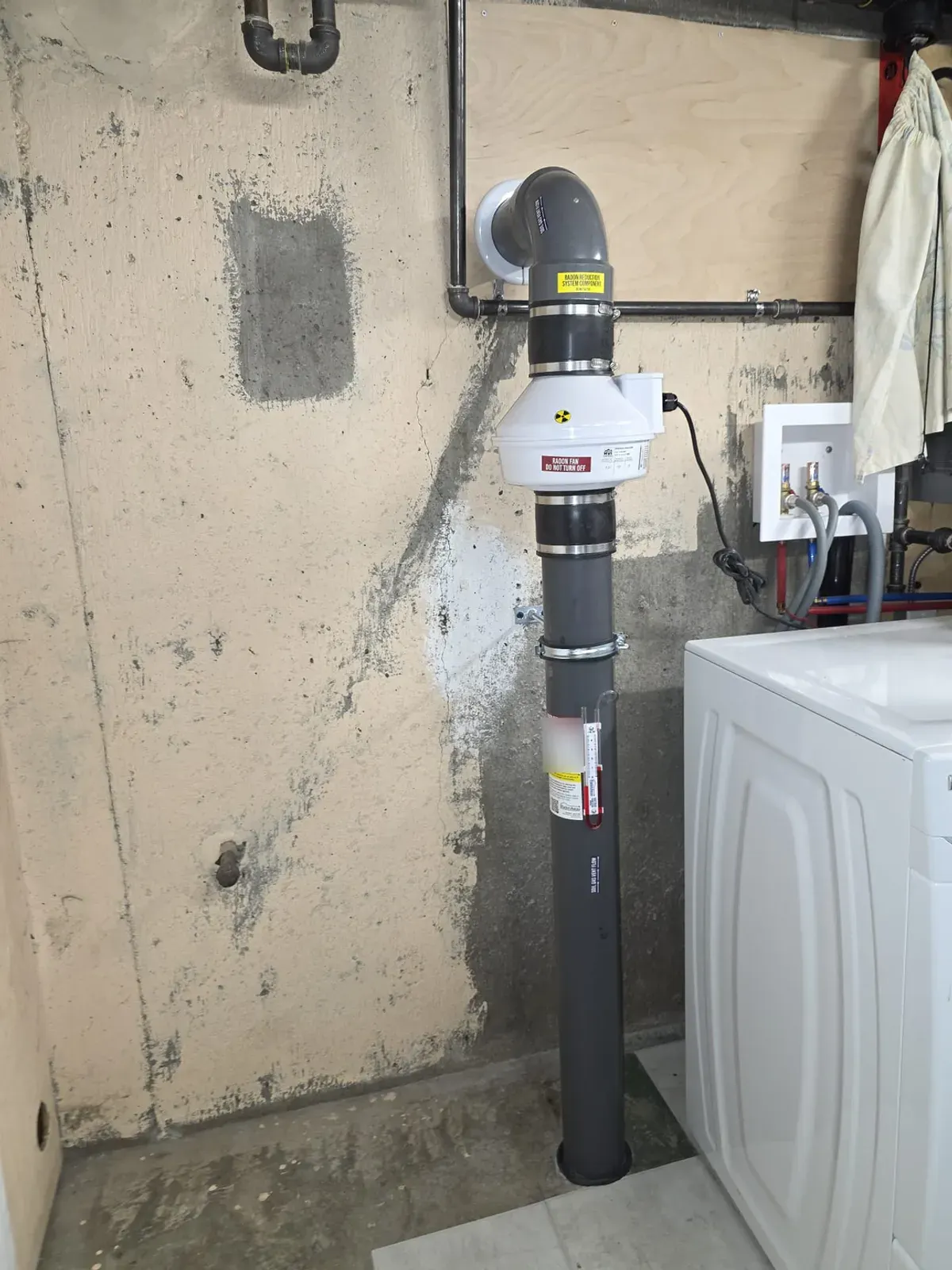
Use the drawing as a map when you stand in front of your own system: the suction point at the floor, the manometer on the pipe, the fan above it and the outlet through the rim joist. The photo shows that arrangement in an older basement with a concrete foundation wall. A system built by another installer may be laid out differently, with the fan in an attic or mounted outside.
Then measure. Health Canada's advice for buyers is to carry out a long-term radon test once they have moved into the new homesource. It does not recommend testing during the real estate transaction itself, because a three-month test is the only way to find out the level accuratelysource. An inspection of the equipment is a separate matter. It can describe the condition of the system, but it cannot put a number on the air, and it should never be presented as if it could. The reasoning is set out under radon and real estate in Calgary.
What does the manometer tell me, and what does it leave out?
It tells you the fan is creating suction in the pipe. It leaves out everything about the air you breathe. Under the Canadian mitigation standard, a U-tube manometer on the pipe indicates that the system is working, and a higher liquid level on one side shows the pressure difference created by the fansource.
The gauge samples one spot. It cannot show whether suction reaches the far corner of the slab. It also cannot tell soil gas from basement air. When a leak close to the pipe feeds the fan with room air, the liquid may sit exactly where it always has while the system does less than it used to. That is one way an owner ends up with a gauge that looks fine and a test result that does not.
A thorough inspection compares the reading with the start-up figure, where one was recorded in the paperwork. Where no figure was ever written down, ask for the reading taken that day to be noted with its date, so the next comparison has something to stand on.
Where do radon systems lose their seal?
At the places where the slab was opened, and at anything that has been disturbed since.
Health Canada names cracks in foundation floors and walls, construction joints, gaps around service pipes, support posts, floor drains and sumps among the places where radon gets insource. A depressurization system depends on those same openings being reasonably tight, because each of them can also let room air into the zone the fan is trying to hold under suction.
The leaks worth looking for are ordinary ones:
- a sump lid lifted to service the pump and set back without its gasket or sealant;
- sealant around the suction pipe that has cracked or pulled away from the concrete;
- a trench cut through the slab for a new bathroom during basement development;
- a floor drain or cleanout left open after plumbing work;
- a crawl space membrane torn by stored boxes or by a trade working underneath the floor.
Sealing is a repair that supports the fan. It does not replace it. Health Canada describes sub-slab depressurization as the most common and effective method, and says that sealing entry routes has a limited effect when used alonesource. For two suction points that carry seals of their own, see sump pit radon systems and their lids and membrane systems for crawl spaces.
Why do systems with outdoor parts have trouble in a Calgary winter?
Because soil gas is moist, and moisture in a cold pipe turns to water and then to ice. Health Canada's Radon Reduction Guide for Canadians (2014) explains that a fan and pipe located outside the heated part of the house cool in the colder months, which can lead to condensation and possibly ice that damage the fan and reduce effectiveness, and that placing the fan indoors with a short discharge near ground level reduces the problemsource.
The timing makes it worse. Health Canada treats the heating season, when windows stay closed, as the period in which indoor radon tends to be highestsource. A system that ices up therefore gives away performance in the very months when a Calgary house most needs it.
The Canadian mitigation standard permits discharge above the roof or through a side wall near ground level, and says the side-wall route shall be favoured in cold weather areassource. That is the layout Plinio Neto builds: fan on the pipe inside the basement, exhaust through the rim joist or side wall, and in some houses above the roof by a route that stays indoors. A house bought with a system may have been built another way.
On such a system the inspection looks for the marks water leaves behind. Staining below a joint is one. A fan housing that sloshes when tapped is another, and so is a gauge that swings during a cold snap. The remedies run from correcting the slope, so that condensate drains back toward the soil, to moving the fan indoors and shortening the outlet.
What is checked at the discharge?
That the outlet is open, undamaged and still suited to its surroundings. The pipe may not have moved, but the house around it often has.
Snow, leaves, nests and garden debris are the simple blockages. Damage from a mower, a ladder or a shifting downspout comes next. The harder question is what has been built nearby since the system went in: a deck over the outlet, a new window well, an air intake added with a replacement furnace, or soil raised against the wall. Where the surroundings have changed, ask whether the outlet still suits the place it was given when the system was built.
Between visits the outlet is the part an owner can watch. Know which wall it is on, and keep that patch of wall clear when shovelling.
Why does an inspection include the furnace and water heater?
Because a radon fan can pull a small amount of air out of the house, and fuel-burning appliances with open flues depend on that air to carry their exhaust up the chimney.
Health Canada recommends making sure that an active depressurization system does not cause backdrafting of combustion appliances such as a furnace, water heater, fireplace or wood stovesource. The Canadian mitigation standard requires a depressurization test after a radon system is installed where the building contains natural draft or other non-sealed combustion appliancessource.
With an inherited system there may be no record that this test was ever carried out. If your house has an older furnace, a water heater with a draft hood, a fireplace or a wood stove, ask for the check and ask for the outcome in writing. Sealed appliances that draw their air from outdoors are a different case, so ask the person inspecting to note which kind you have.
How long does the fan in an older system last?
There is no fixed date. In its Radon Reduction Guide for Canadians (2014), Health Canada puts the lifespan of a radon fan anywhere between five and ten or more yearssource.
A range that wide makes age a weak guide when taken alone. The installation date on the label or invoice shows roughly where your fan sits in it. What the inspection adds is evidence: the sound of the bearings, the suction on the gauge and any trace of water in the housing. Before agreeing to a new fan, ask what that evidence shows; age alone is a weak reason to replace one.
Can a system be repaired or upgraded instead of rebuilt?
Often, yes. The opening through the floor and the route to the outdoors are the hardest parts to create, and where they are sound they can be reused.
| Finding | Possible repair | What to recheck afterwards |
|---|---|---|
| Sump lid or pipe seal left open | Reseal the lid, grommets or pipe collar. | Manometer reading against the start-up figure, if one is on record. |
| Slab cut during basement development | Close and seal the opening. | Whether suction still reaches that part of the floor. |
| Suction does not reach one area of the slab | Add a suction point tied into the existing pipe. | Pressure under the slab at test holes. |
| Water collecting in a section of pipe | Correct the slope or re-route that section. | Sound in the pipe and stability of the gauge. |
| Outdoor fan with repeated icing | Move the fan indoors with a short side-wall outlet. | Start-up reading, then a winter of normal use. |
| Fan worn out or badly matched to the soil | Fit a fan chosen from measured suction and airflow. | A new start-up reading, written down with its date. |
| Gauge missing or unreadable | Fit a U-tube manometer below the fan. | A first reading, recorded with the date. |
| No label and no records | Write a new label and start a file. | That the next owner can follow what was done. |
For buildings that already exist, the Canadian standard on radon mitigation is CAN/CGSB-149.12-2024, Radon mitigation options for existing buildingssource. Health Canada's recommendation is to hire a professional who is certified by the Canadian National Radon Proficiency Program (C-NRPP)source. Inspections and repairs arranged through Calgary Radon Pro are carried out by Plinio Neto, who holds the C-NRPP mitigation credential (CRMT-202966) and the measurement credential (CRT-202965). Both are personal to him and can be looked up in the C-NRPP directory of professionals.
A written quote for repairs should list each item on its own line, so you can tell what is necessary from what is merely an improvement. For how repair work compares with a new installation, see the guide to radon mitigation costs in Calgary. Our guide on how to choose a radon contractor lists the questions worth asking before anyone opens the system.
How is a repair confirmed?
By measuring the air again. A corrected gauge shows that suction has returned. Only a radon test shows what that suction has done to the level.
The figure that goes on record comes from a long-term kit supplied by an independent laboratory, placed and mailed by the owner. Ask whether the repair quote includes a short reading by the installer once the work is done; such a reading is a first check and not the record. Health Canada recommends testing again after a system is installed, retesting homes with active mitigation systems every 5 years, and testing after any renovation that affects the structure or ventilation of the homesource. That list does not name repairs. Testing again after a substantial repair is our own suggestion, and it is not a Health Canada recommendation. The measurement Health Canada recommends lasts 3 to 12 months, with 91 days as the minimumsource.
Health Canada's recommendation to take corrective action applies when the annual average is above 200 Bq/m³source. Below that figure the decision belongs to the owner, bearing in mind that no level is considered risk-free and lower is better.
The steps are described under testing once a radon system is in place. To make sense of a report, try the radon result checker or read our guide to reading a radon test report. For the design principles behind every system on this page, go to radon mitigation in Calgary.
Frequently asked questions
What does a radon system inspection check?
The manometer reading and actual suction, fan condition and noise, electrical connection, pipe joints and supports, seals around the pipe and sump, slab cracks that have opened since installation, the exhaust location, labelling, and recent test results.
I bought a house with a radon system. What should I do first?
Find the installation paperwork and any before-and-after results. Check that the manometer shows suction and the fan runs. Then run a long-term test once you have moved in, with at least 91 days of it in the heating season, as Health Canada advises. An inspection makes sense if there's no documentation, the manometer looks wrong or results are high.
Why would radon rise again in a house with a working fan?
New cracks in the slab, a sump lid that's been opened and not resealed, renovations that created new openings, a basement developed over an untreated area, or changes in ventilation can all let radon in faster than the system removes it. An inspection looks for what changed.
Can a system be upgraded instead of replaced?
Often. Adding a second suction point, sealing new entry points, changing the fan or improving the pipe route can restore performance without starting over.
What causes ice to form at the exhaust?
Health Canada's Radon Reduction Guide for Canadians (2014) explains that a fan and pipe located outside the heated part of the house cool in the colder months, which can lead to condensation and possibly ice that damage the fan and reduce effectiveness. The same guide says that placing the fan indoors, with a short discharge near ground level, reduces the problem. If you see ice building up at an outlet, ask for the system to be inspected.
Is it safe to turn the system off for a while?
A radon system lowers the level only while its fan is running, so we do not describe any period with the fan off as safe. If the system has to be switched off for a repair or other work in the house, switch it back on as soon as that work allows. Then look at the manometer: a higher liquid level on one side shows the fan is creating suction again.
How often should a system be inspected?
Look at the manometer yourself from time to time. A professional inspection is useful when buying a home with a system, when readings change, or after major renovations. For the air itself, Health Canada recommends retesting a home with an active system every 5 years, and after any renovation that affects the structure or ventilation.
Sources
- CAN/CGSB-149.12-2024, Radon mitigation options for existing buildings
- Health Canada, Radon in real estate
- C-NRPP, Find a Professional and Certification Check
- Health Canada, About radon
- Health Canada, Reducing radon levels in your home
- Health Canada, Radon Reduction Guide for Canadians, 2014
- Health Canada, Guide for Radon Measurements in Residential Dwellings (Homes)
Calgary Radon Pro serves Calgary, Airdrie, Cochrane, Okotoks and Chestermere.
Start with a measurement
Send your details and your latest test result if you have one. We reply by email with the next step for your home.