Radon mitigation in Calgary
Radon mitigation lowers the radon level in a home by changing where soil gas goes. The standard method, sub-slab depressurization, uses a sealed pipe and a small fan to draw gas from under the basement floor and release it outdoors. Health Canada recommends it when a long-term test is above 200 Bq/m³, within one year. Most systems go in within a day and, in most homes, cut radon by more than 80%. A short verification reading and an independent long-term test confirm the result.
Request a quote
Tell us about your home. We reply by email with the next step. No obligation.
Prefer email? contact@calgaryradonpro.ca
When does a home need mitigation?
When a long-term test puts the annual average above the guideline. Health Canada's guideline for indoor air is 200 Bq/m³, and it recommends corrective action above that levelsource. The recommended window is one year, shorter for higher results, with the aim of getting radon as low as reasonably achievablesource.
Mitigation is also a legitimate choice below 200 Bq/m³. Some owners act at 150 Bq/m³ because a child sleeps in the basement, or because they would sooner not carry a result that close to the line into a future sale. What mitigation should never rest on is a guess. If the only number you have comes from a test of a few days, confirm it with a long-term test first, unless it is several times the guideline. Our page on radon levels and the Canadian guideline sets out how fast to move in each range.
How does a radon mitigation system work?
It keeps the air under the house at a lower pressure than the air inside it, so soil gas flows into a pipe instead of into the basement. Health Canada describes sub-slab depressurization as the most common and most effective method, and notes that extra ventilation or sealing on their own have limited effectsource.
The parts are few. A hole is cored through the slab and a small pit is hollowed out beneath it. A pipe is sealed into that hole and connected to an in-line fan that runs all the time. The fan pulls air from the gravel and soil under the floor and pushes it outside, where it mixes with outdoor air. A simple gauge on the pipe shows that suction is present. Cracks and open joints near the suction point are sealed so the fan pulls from the soil and not from the room.
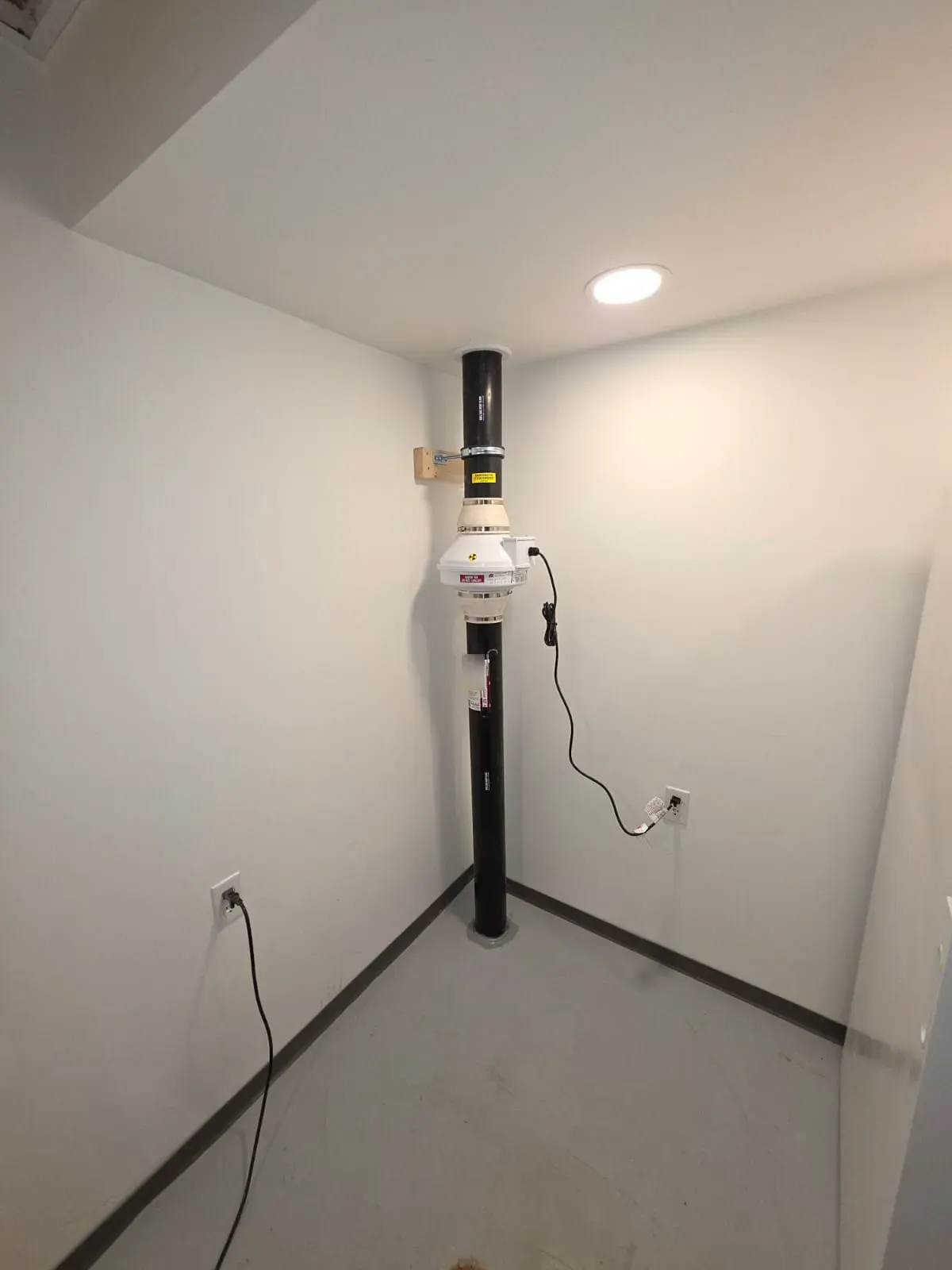
The drawing shows the layout Plinio Neto installs most often: the fan on the pipe inside the basement, and the exhaust leaving through the rim joist at the side of the house. Our guide to how a mitigation system works goes through the physics.
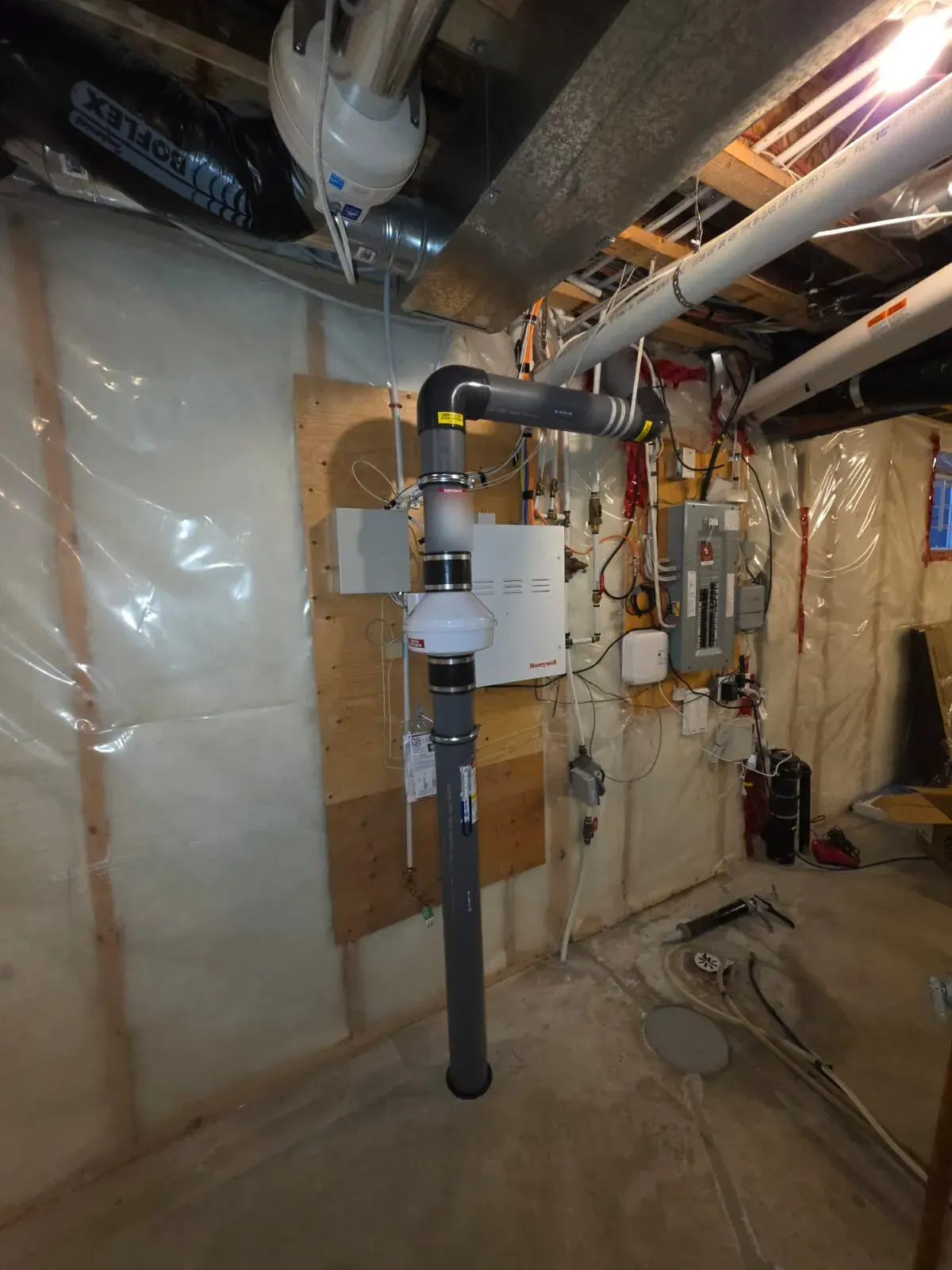
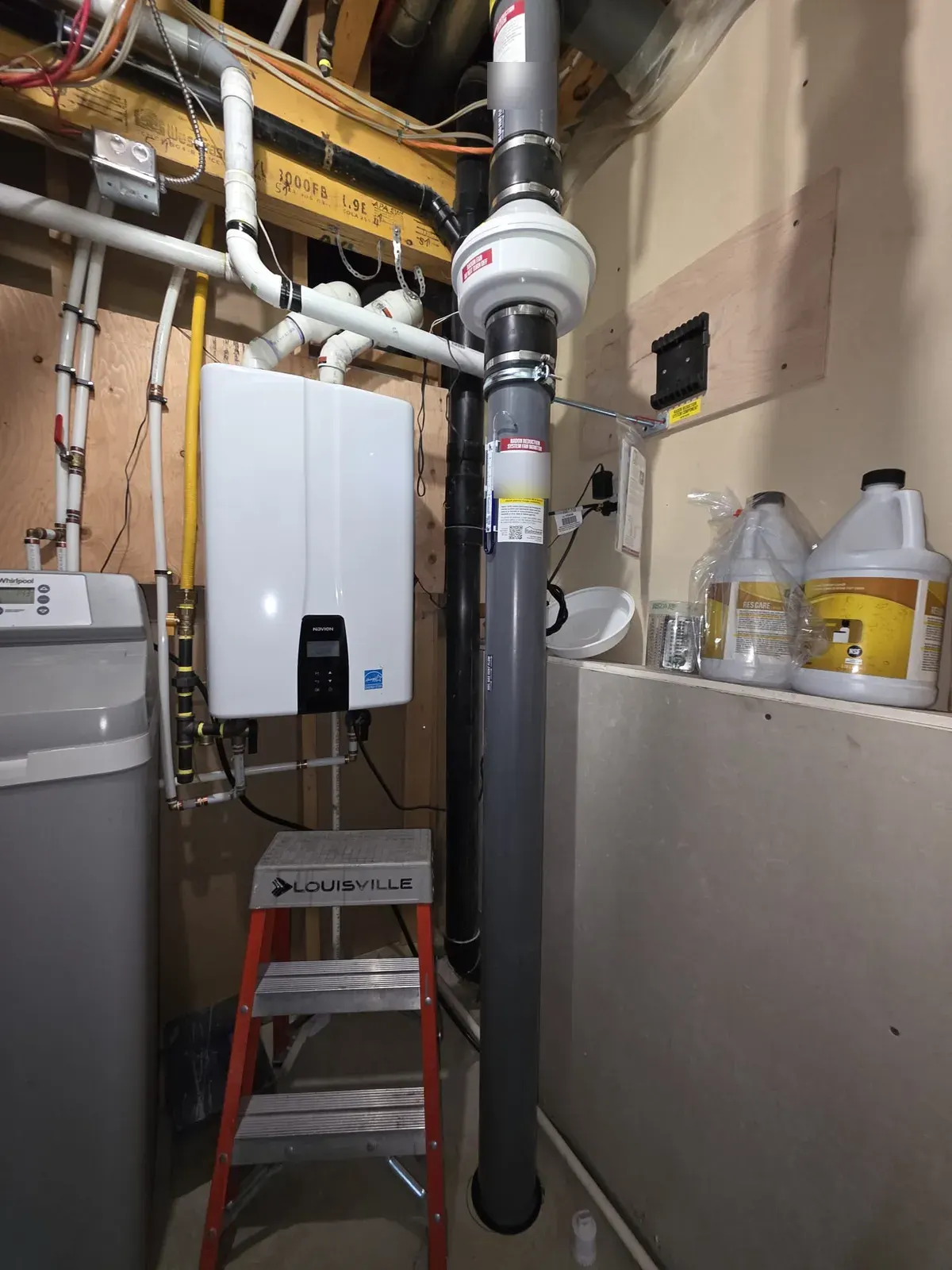
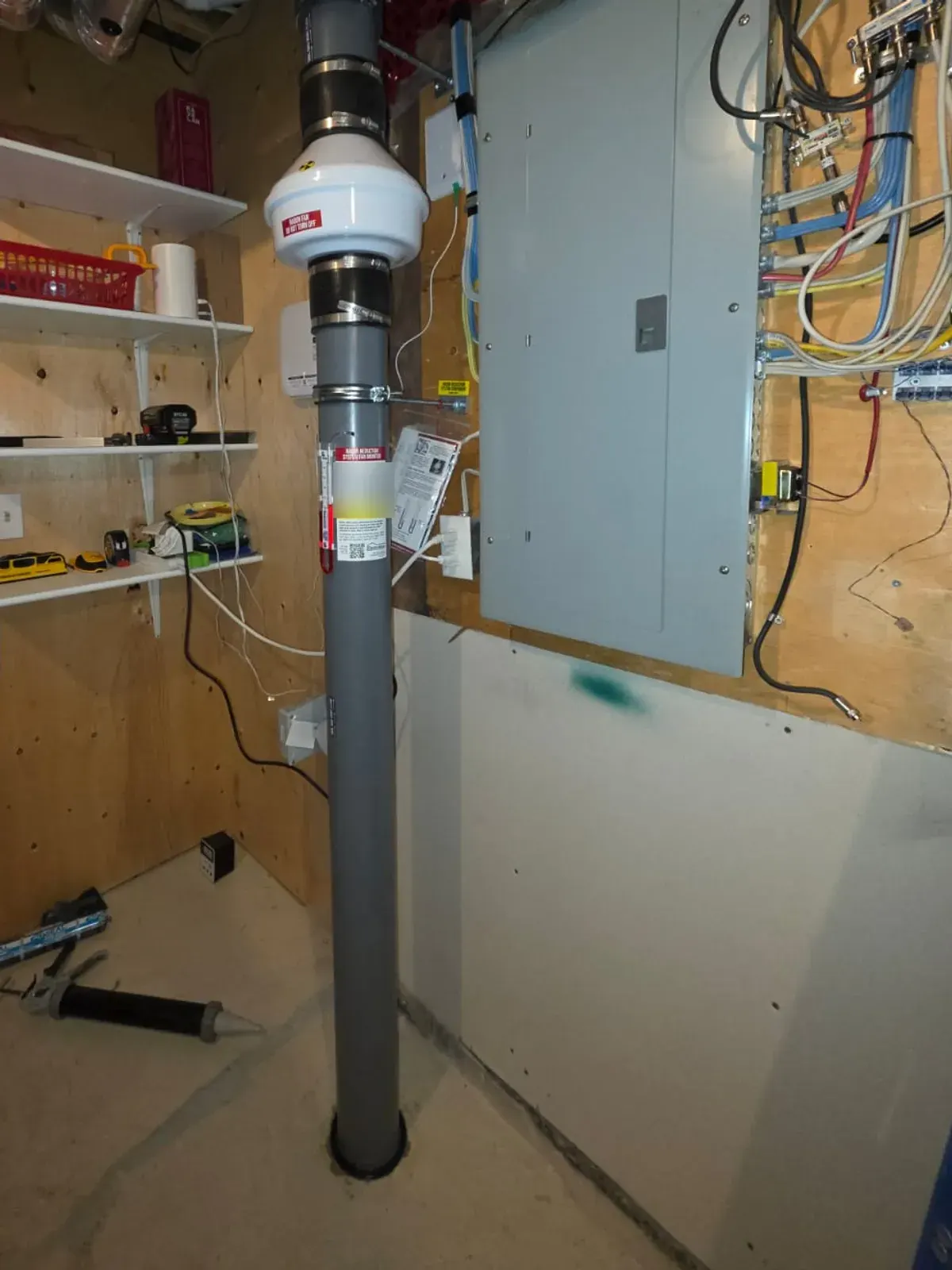
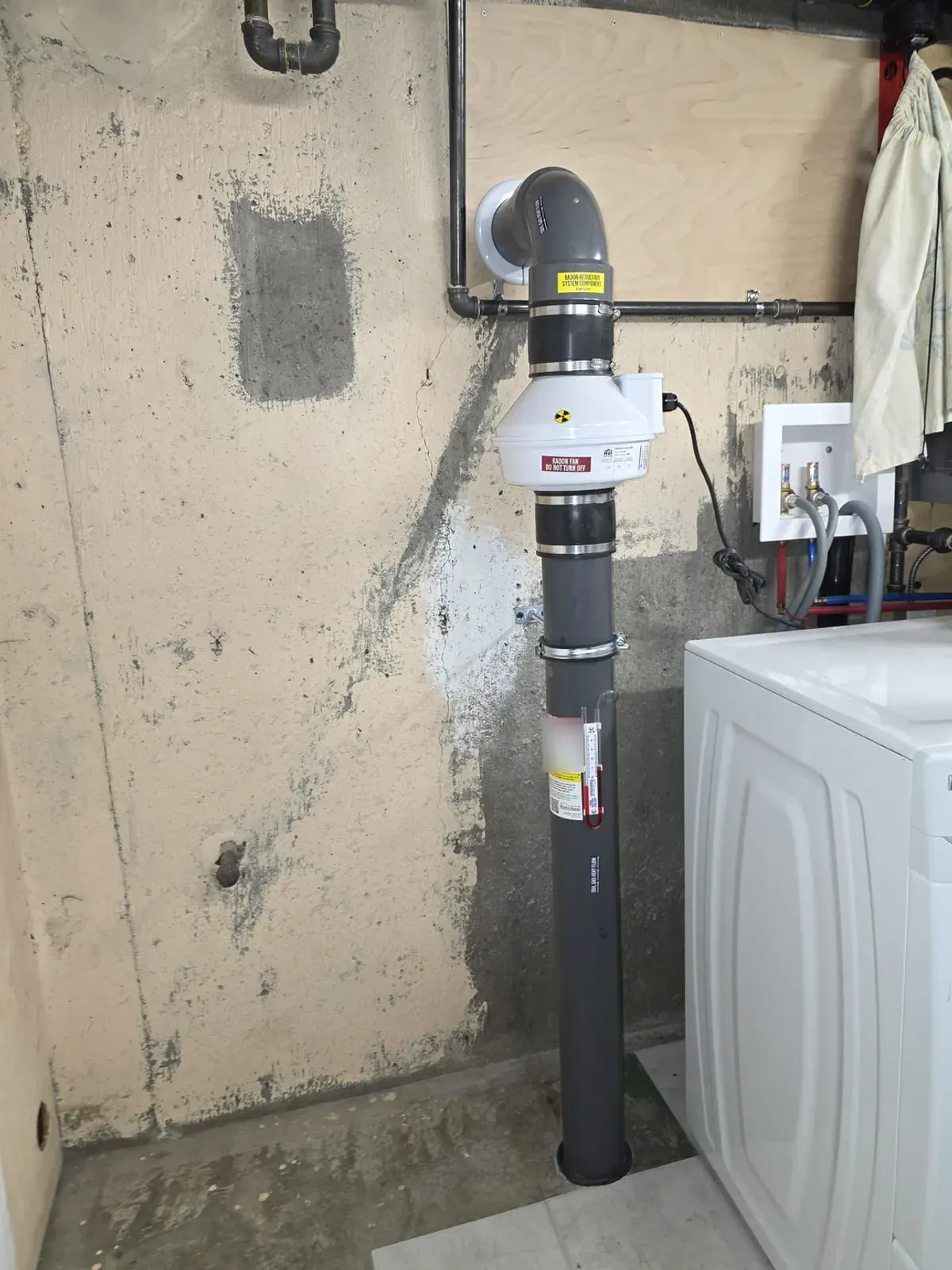
The photo beside it is the same layout in an unfinished basement. The four below show it in other Calgary homes: beside a tankless water heater, next to an electrical panel, against an older concrete foundation wall and in the corner of a finished room.
Which system does my Calgary home need?
The foundation decides. A full basement on a concrete slab, the most common case in Calgary, takes a standard sub-slab system. Other foundations use the same principle with a different way of reaching the soil.
| Foundation | Usual method | What to know |
|---|---|---|
| Basement with a concrete slab | Sub-slab depressurization through a cored suction point | One suction point is often enough when there is gravel under the slab. Tight soil or a large floor can need a second. |
| Basement with a sump pit | Sealed sump lid used as the suction point | Works well when the pit connects to the weeping tile. The pump stays in place and remains serviceable. |
| Crawl space with exposed soil | Sub-membrane depressurization | A sealed membrane covers the soil and the fan draws from beneath it. |
| Basement plus crawl space or addition | Combined system | Both areas are treated, often with two suction points joined to one fan. |
| Slab-on-grade | Sub-slab depressurization | Same method as a basement; the pipe route is the main design question. |
| Newer home with a rough-in | Rough-in activation | The capped stub left by the builder becomes the suction point once it has been tested. |
Each of these has its own page: sump pit systems, crawl space systems and rough-in activation.
| Method | Relative effect | When it is used |
|---|---|---|
| Sub-slab depressurization | Highest | The default for any home with a slab. |
| Sump pit depressurization | High | When a sump is connected to the drainage tile around the footings. |
| Sub-membrane depressurization | High | Crawl spaces and other areas of exposed soil. |
| Increased ventilation (for example an HRV) | Limited on its own | As a complement, or where the starting level is only slightly elevated. |
| Sealing cracks and openings | Limited on its own | Always done alongside depressurization so the fan works efficiently. |
How much does radon mitigation cost in Calgary?
The price follows the work. A single suction point with a short pipe run in an unfinished basement sits at the low end. More suction points, a long or awkward pipe route, a finished basement that limits access, and electrical work for the fan each add to it. A written quote comes after an on-site assessment, because the things that set the price cannot be seen from a photo of the house. Our cost guide for Calgary lists the ranges by system type and what each includes.
What does the on-site assessment cover?
Everything the design depends on. The installer looks at the foundation type and the condition of the slab, checks for a sump pit, a crawl space or an addition on a separate footing, and finds out whether the builder left a rough-in. Possible suction points are compared, along with the pipe route from each, the place for the fan, the nearest power and the spot where the exhaust can leave the house. In a finished basement the question is which closet, utility room or storage area lets the pipe pass with the least disturbance. Bring your test report: the starting level sets how much reduction the design has to deliver.
What happens on installation day?
Health Canada notes that a radon reduction system can usually be installed in less than a daysource. The work follows the same order in most houses.
- Walk-through. The installer confirms the suction point, pipe route, fan position and exhaust location agreed at the assessment.
- Diagnostics. A small test hole and a vacuum show how freely air moves under the slab, which settles whether one suction point will do.
- Coring. A hole is cut through the slab and a pit is dug out under it by hand.
- Piping. The pipe is sealed into the slab, supported and run to the fan and on to the outside.
- Fan and power. The fan is mounted and connected, and the gauge is fitted to the pipe.
- Sealing. Nearby cracks, the floor-to-wall joint and any open sump are sealed.
- Start-up. The fan is switched on, suction is checked at the gauge and the system is labelled with the installer and date.
Expect some noise while the slab is cored and a little dust around that spot, which is cleaned up before the installer leaves. You can stay in the house throughout.
Where do the pipe and fan go?
Wherever the route is shortest, protected and least in your way. In many Calgary basements that means a utility room: the pipe rises from the slab beside the furnace, the fan sits on it just below the floor joists, and the exhaust passes out through the rim joist. The Canadian mitigation standard allows discharge above the roof or through a side wall near ground level, and says the side-wall option shall be favoured in cold weather areassource.
A side exhaust keeps the whole system indoors except for the last few centimetres, which matters in a climate with long cold spells: there is no exterior pipe run to collect frost. The alternative is a pipe carried up through the inside of the house to discharge above the roof line. It suits some layouts better, for example where no side wall offers a suitable outlet position. The assessment shows which routes your house allows.
What results should I expect?
Health Canada reports that, in most homes, a radon reduction system lowers the level by more than 80%source. Where a particular house lands depends on its starting level, the material under the slab and how completely openings can be sealed. Nobody can responsibly promise a final number before the fan is running, and we do not.
The target is not just to get under 200 Bq/m³. Health Canada's guidance is to bring radon as low as reasonably achievable, and a well-designed system usually goes far below the guideline.
How do you confirm it worked?
By testing again, in two stages, and the second stage is not done by us. After the system has been running, Plinio Neto takes a short verification reading with a monitor to show that the fan is pulling the level down. The confirmation that counts is a long-term test of at least 91 days in the next heating season, and for that we ask you to use an independent laboratory kit that you place and mail yourself. The result comes from the laboratory to you, not through the people who installed the system. We don't grade our own work.
If the level has not dropped enough, the cause can be found: a slab area the suction does not reach, an entry point that was missed, or a fan that needs to be a different size. The usual remedy is an added suction point or further sealing. See testing after mitigation for timing.
Is radon removal different from radon mitigation?
No, they are two names for the same service. "Removal" is the word many people search for. "Mitigation" is the accurate one, because no system takes radon to zero. It is present outdoors too, and a home's level can only be reduced, not erased. A contractor who promises complete removal is promising something that cannot be measured.
What is particular about Calgary homes?
Three things come up again and again. Most houses have full basements, and many of those basements are developed into bedrooms, offices or rental suites, so people spend long hours on the level closest to the soil. A finished basement does not prevent a system; it changes where the suction point and pipe can go.
Second, newer houses are not exempt. University of Calgary research found radon in new Canadian houses has risen since about 1980source, and much of the city's housing was built after that date. Our Calgary radon map and risk guide collects the local studies.
Third, recent builds come with a head start. Alberta's building code, the National Building Code 2023 Alberta Edition, requires a radon rough-in with a pipe stub in new homessource. A rough-in is not a working system. When a test in such a home comes back high, the stub usually makes the installation simpler.
Who installs the system, and to what standard?
Health Canada recommends hiring a professional certified by the Canadian National Radon Proficiency Program (C-NRPP)source. Systems booked through Calgary Radon Pro are installed by Plinio Neto, C-NRPP certified mitigation professional (CRMT-202966). The certification is his personally, and anyone can check it in the C-NRPP public directory.
The national standard for this work is CAN/CGSB-149.12-2024, Radon mitigation options for existing buildingssource. Ask any installer which standard their work follows and whether a follow-up test is part of the job.
What maintenance does a system need?
Very little, and most of it is looking. The U-tube gauge on the pipe, called a manometer, sits higher on one side while the fan is creating a pressure differencesource. Glance at it every month or two. Level liquid means the fan may have stopped or lost power, or the small gauge tube may have come loose. Keep the outside outlet clear of snow and ice in winter.
The fan is the only moving part and will eventually need replacing; see radon fan replacement. Health Canada recommends retesting a home with an active system every five years, and after renovations that affect its structure or ventilationsource.
Frequently asked questions
What is sub-slab depressurization?
Sub-slab depressurization is the standard way to lower radon in homes with a basement or slab floor. A hole is cored through the concrete, a small pit is dug beneath it, and a sealed pipe connects that pit to an in-line fan that runs continuously. The fan keeps the air under the slab at lower pressure than the house, so soil gas is pulled out and vented outdoors instead of drifting inside.
How much will a system lower my radon level?
Health Canada reports that a radon reduction system lowers levels by more than 80% in most homes. The final number depends on your starting level, the soil and gravel under the slab, and how well the foundation can be sealed. A follow-up test, not an estimate, is what shows your actual result.
Where will the pipe run in my house?
The pipe starts at the suction point in the basement slab and stays inside the house, usually in a utility room or closet, until it reaches the discharge point at the rim joist or, in some layouts, above the roof. The route is chosen to keep the pipe short, protected from freezing and as unobtrusive as possible, while meeting the clearance rules of the Canadian mitigation standard for where exhaust can be released.
Can you install a system in a finished basement?
Usually, yes. The suction point is placed where it disturbs the finish least, often in a utility or storage room, under stairs, or in an unfinished corner. When no exposed slab is available, the installer may cut a small, neat opening in flooring and patch around the pipe. Your assessment will show the proposed location before work begins.
What if my home has a sump pit, a crawl space or more than one foundation type?
Each of these changes the design. A sump pit can be sealed and used as the suction point, a crawl space is covered with a sealed membrane that is depressurized, and homes with a basement plus a crawl space or addition may need two connected suction points. Our pages on sump pit and crawl space mitigation explain each approach in detail.
Does a radon system need maintenance?
Very little. Check the manometer every month or two; if the liquid levels are uneven, the fan is pulling suction. Keep the exhaust clear of snow and ice, and plan for a fan replacement eventually, since fans are the one moving part. Health Canada recommends retesting a home with an active system every five years, and after renovations that affect the structure or ventilation.
Is radon mitigation the same as radon removal?
Yes, the two terms describe the same work. "Removal" is common in searches, but no system removes all radon; it is present in outdoor air too. Mitigation means reducing indoor levels as low as reasonably achievable, which is the goal Health Canada sets. A good result is a large, measured reduction, not a promise of zero.
Will a radon system affect selling my home later?
A working system with documented before-and-after results is generally an asset in a sale, because it answers a question buyers increasingly ask. Keep your test reports, installation details and any service records together. A buyer's own test should confirm the system is doing its job. We can't predict market value effects, but documentation removes uncertainty.
How do I know the system is working day to day?
Look at the manometer, a small U-shaped gauge mounted on the pipe. When the fan is running and pulling air from under the slab, the liquid sits at different heights on each side. Equal levels mean no suction, which usually points to a fan or power problem. Some systems also have an audible or visual alarm.
What standard should a Calgary radon installation follow?
In Canada, mitigation of existing buildings is guided by the national standard CAN/CGSB-149.12-2024, and C-NRPP certified professionals are trained to it. The standard sets out how systems are designed, installed and checked. Ask any installer which standard they follow and whether the work includes a follow-up test.
Sources
- Health Canada, Guide for Radon Measurements in Residential Dwellings (Homes)
- Health Canada, Reducing radon levels in your home
- National Building Code – 2023 Alberta Edition, Division B, Sentence 9.13.4.2.(2) and Article 9.13.4.3 (National Research Council of Canada)
- University of Calgary News, 2021
- CAN/CGSB-149.12-2024, Radon mitigation options for existing buildings
- CAN/CGSB-149.12
- Health Canada, Radon Reduction Guide for Canadians, 2014
Calgary Radon Pro serves Calgary, Airdrie, Cochrane, Okotoks and Chestermere.
Start with a measurement
Send your details and your latest test result if you have one. We reply by email with the next step for your home.