Radon mitigation through your sump pit
In a basement with a sump pit, the pit can serve as the suction point of a radon system. The open pit is covered with an airtight lid, a pipe is connected through that lid, and a fan draws soil gas along the drainage tile at the footings and sends it outdoors. The sump pump stays where it is and stays serviceable. The approach works when the pit truly connects to the tile, and a follow-up test shows whether it has done enough.
Request a quote
Tell us about your home. We reply by email with the next step. No obligation.
Prefer email? contact@calgaryradonpro.ca
Why is the sump pit a useful place to draw from?
Because it is already a hole through the slab, and it is often joined to a pipe that circles the house. Health Canada lists sumps and floor drains among the routes by which radon enters, along with foundation cracks, construction joints and gaps around service pipes, all driven by indoor air pressure that is usually lower than the pressure in the soilsource. An uncovered pit is therefore both a problem and an opportunity. Left open, it lets soil gas into the room. Sealed and put under suction, it becomes the place where that gas is collected.
The opportunity comes from the weeping tile, the perforated drain laid beside the footings to carry groundwater to the pit. That drain sits in gravel, and gravel lets air move. A fan pulling on the pit pulls on the drain, and through the drain it reaches soil along every wall the tile follows. Health Canada describes sub-slab depressurization as the most common and effective way to reduce radonsource, and a sump connection applies the same principle through an opening the builder has already made.
How do we find out whether the pit reaches the weeping tile?
By looking first and measuring second. Lifting the existing cover usually shows whether pipes enter through the pit wall. A liner with open pipe ends is a good sign. A plain bucket set in concrete with no inlets is not: it may collect seepage through its own perforations and nothing more.
Seeing a pipe is not proof that the tile is continuous, so the next step is a pressure check. A temporary cover is placed on the pit, a test fan or vacuum applies suction, and small holes drilled through the slab at a distance show whether that suction arrives. If the far corners of the basement respond, the tile is doing the distribution work. If only the area beside the pit responds, the design needs something more. This is the same diagnostic logic used for any slab system, described on our main page about how radon mitigation systems are designed for Calgary houses.
The assessment also notes what else empties into the pit. Floor drains, a laundry standpipe, a water softener line or a dehumidifier hose are each a possible air leak once the pit is under suction, and each has to be accounted for in the lid design.
What is the sealed lid made of, and what passes through it?
A rigid cover, a gasket and a set of sealed openings. The lid has to hold a vacuum, bear the occasional foot, and still come apart when the pump needs attention. Loose plastic covers that simply rest on the rim do none of those jobs.
| Part | What it does | Why it matters |
|---|---|---|
| Rigid cover | Spans the pit and resists the pull of the fan | A cover that flexes breaks its own seal |
| Gasket or sealant at the rim | Closes the joint between cover and floor | This joint is the longest potential leak on the lid |
| Radon pipe port | Connects the suction pipe to the air space above the water | Sets where the fan draws from |
| Discharge pipe grommet | Seals around the pump outlet pipe | The pipe vibrates each time the pump starts, so the seal must tolerate movement |
| Cord grommet | Seals around the pump and float cables | Small gaps here add up to a steady leak of room air |
| Viewing window | Lets you see the water level and the float | No need to open the lid for a routine look |
| Removable access section | Opens for pump service and reseals afterwards | Keeps the pump replaceable without cutting the lid apart |
Extra lines get the same treatment. A hose from a dehumidifier or softener passes through its own sealed fitting instead of being pushed under the edge. A floor drain that runs to the pit is fitted with a trap or a one-way seal, so water still flows down while room air is not pulled along the drain line into the pit. A high-water alarm, if there is one, has its sensor wire routed through a grommet like the pump cord.
Pump style matters as well. A submersible pump sits entirely below the lid and is simple to seal over. A pedestal pump has its motor on a column above the pit, which leaves a moving shaft passing through the cover. That is hard to make airtight, and replacing the pump with a submersible model is often part of the job.
Where do the pipe, fan and exhaust go from the pit?
From the lid, the pipe rises to an in-line fan and continues to the outdoors by the shortest protected route. Sump pits tend to sit in a corner or a utility area, close to an outside wall, which often makes for a short run. The Canadian mitigation standard permits discharge either above the roof or through a side wall near ground level, and states that side-wall discharge shall be favoured in cold weather areassource.
The pipe enters the lid above the highest level the water normally reaches, so the fan moves air and never lifts water. A section near the lid is joined with a removable coupling. When the pump needs work, that coupling is loosened and the cover can be lifted without cutting anything.
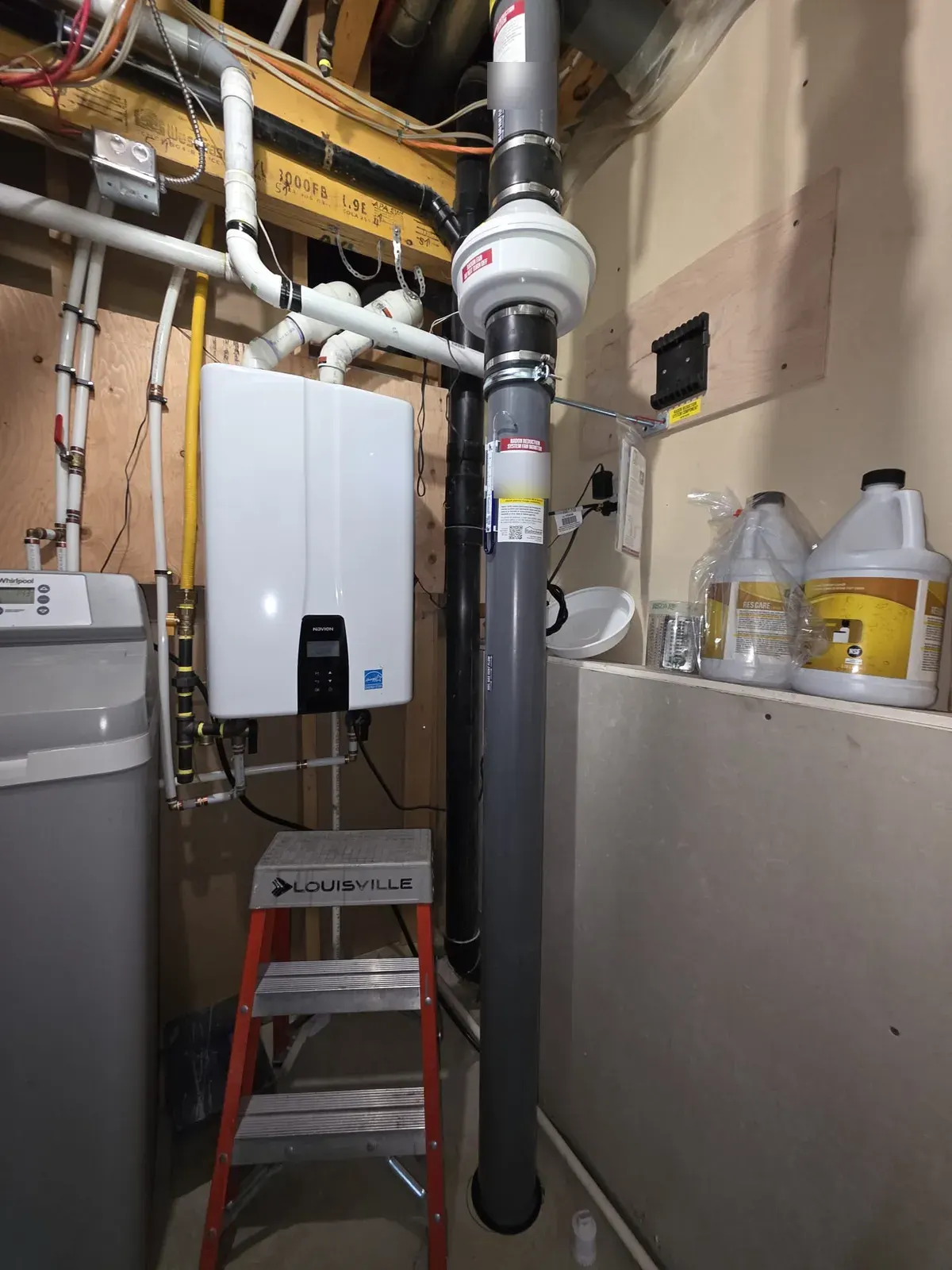
The photo shows the upper half of a system of this kind in a Calgary utility room: the fan mounted on the pipe indoors, with the run continuing toward the outside wall. The sealed lid itself is in the drawing above. Work is carried out by Plinio Neto, C-NRPP certified mitigation professional (CRMT-202966), whose listing is in the C-NRPP register of certified people.
Health Canada's recommendation is to hire someone certified by the Canadian National Radon Proficiency Programsource. The Canadian standard for mitigation work in houses that are already built is CAN/CGSB-149.12-2024, Radon mitigation options for existing buildingssource.
How do the pump and the radon system share one pit?
They do separate jobs in the same space, and neither should notice the other. The pump handles water and the fan handles air. Groundwater arrives through the tile, the float rises, the pump empties the pit through its discharge line, and the fan keeps drawing from the air space the whole time.
The discharge line needs one check. It leads outdoors, and when the pump is idle it can act as an open pipe from the yard into the pit. A check valve on that line, which most installations have for plumbing reasons anyway, also stops the fan from pulling outside air backwards through it. A missing or stuck valve is something the quote for a sump connection should deal with.
Spring melt is the season people ask about. When the water table rises and the tile runs full, less of it is open to air, and the suction field can shrink for a while. That is a known limit of drawing through a drain. It is one reason the follow-up measurement described further down this page matters.
What happens on installation day?
Health Canada notes that a radon reduction system can usually be installed in less than a daysource, and a sump connection is typically among the less disruptive jobs because no new hole is cored through the floor. The usual order is:
- The pump is unplugged and lifted out, and the pit is cleaned of silt and debris.
- The rim is prepared so the new cover has a flat, clean surface to seal against.
- The pump goes back in, with its check valve inspected and its discharge pipe and cables threaded through the lid.
- The cover is set, fastened and sealed, and every opening through it is closed.
- The suction pipe is connected, supported and run to the fan and on to the exterior.
- The fan is wired and started, and the gauge on the pipe is read.
- Suction is checked at the test holes across the slab, and those holes are then patched.
- The pump is run through a full cycle with the fan on, to confirm that both work together.
When is a sump pit the wrong suction point?
When pulling on it does not pull on the soil under the rest of the house. A pit is only as good as what it is attached to, and several ordinary conditions break that link. None of them rules out mitigation. They change where the suction is applied.
| Condition | What goes wrong | Usual answer |
|---|---|---|
| Pit with no tile connection | Suction stays in the pit and its immediate surroundings | Seal the pit and core a separate suction point through the slab |
| Tile that covers only part of the perimeter | One side of the basement shows no pressure response | Keep the sump connection and add a slab suction point on the weak side |
| Tile blocked with silt or crushed | Air cannot travel past the blockage | Treat the pit as local suction only and add points where needed |
| Tile open to daylight or to a storm connection | The fan pulls outdoor air through the open end | Close or trap the open end if possible; otherwise use the slab |
| Pit that stays nearly full of water | Little air space is left for the fan to draw from | Seal the lid and place the suction point elsewhere |
| Addition or crawl space on its own footing | The original tile does not extend under the newer part | A combined system with a second suction point for that area |
| Cracked or crumbling pit liner and rim | The lid has nothing sound to seal against | Repair the rim first, then decide |
In each of these cases the pit should still be given an airtight cover. An open sump beside a working system is a leak that makes the fan pull room air, and it remains a path for soil gas whenever the fan is off. Homes with exposed earth in part of the foundation are covered on our page about crawl space radon mitigation with a sealed membrane.
What upkeep does a sump system need?
A regular glance at the gauge, and care whenever the lid is opened. The U-tube manometer on the pipe shows the system is working when the liquid stands higher on one side, which reflects the pressure difference made by the fansource. On a sump system the gauge can also drift a little as the water level moves, so learn what normal looks like in a dry month and in a wet one.
- Look through the window now and then to confirm the float moves freely and the water is where you expect.
- Test the pump the way its manufacturer recommends, using the access section and closing it firmly afterwards.
- After any plumber's visit, check that every fastener is back and every grommet is seated. A lid left loose after pump service is a common reason a sump system quietly loses performance.
- Keep the outdoor outlet clear of snow, leaves and stored items.
- Do not run new hoses or cables under the edge of the cover; ask for a proper fitting.
The fan is the single moving part of the radon system and will need replacing eventually; that service is described under radon fan replacement in Calgary. Health Canada recommends testing after a system is installed, retesting every five years while it remains active, and testing again after renovations that change the structure or ventilationsource. Swapping a pump for a similar one changes neither. A basement development that moves the pit or boxes it in is a different matter.
What should Calgary homeowners know about their own basements?
That the starting point is a measurement, and that a sump is neither required for mitigation nor a sign of a radon problem. The Cross-Canada Survey of Radon Exposure found about 1 in 6 houses in the Calgary area at or above 200 Bq/m³source. Some local basements have a pit with a pump, some have a dry pit that has never held one, and some drain to a floor drain only. The assessment works with whatever is there.
Newer houses may offer two candidate suction points. Alberta's building code, in the National Building Code 2023 Alberta Edition, calls for a radon rough-in with a pipe stub in new homessource. Where a house has both a stub and a sump, the pressure check decides which one reaches more of the slab, and the other is sealed. The stub route is described on the rough-in activation page. In either case the open pit is covered, since the builder's stub does nothing about the sump beside it.
Many pits here end up behind a wall or under a hatch once a basement is finished. That does not prevent the work, but access has to be restored and kept. If you are planning a development, leave the pit reachable and tell the framer why.
How is the result confirmed, and what does it cost?
By testing, in two steps. The installer takes a short verification reading once the fan has been running, which shows the immediate change. The figure that counts comes from a long-term test with an independent laboratory kit that you place and mail yourself, so the installer is not grading his own work. Health Canada's measurement period is three to twelve months, with a minimum of 91 dayssource. The result is compared with the Canadian guideline of 200 Bq/m³, an annual averagesource, and the stated aim is to bring levels as low as reasonably achievable, acting within one year when a home is above the guidelinesource. If the number has not come down far enough, the table above usually explains why, and the remedy is an added suction point. No installer can honestly promise a final figure in advance. You can place any reading with the radon test result checker or read the Canadian guideline explained range by range.
What moves the price is the pit, not the pipe: a damaged rim, a pedestal pump that has to be swapped, extra lines to seal, or a tile that turns out to be partial and calls for a second suction point. The comparison with other system types is in what radon mitigation costs in Calgary. Two guides go further into the details: choosing and sealing a radon sump pit lid and which parts of radon mitigation are realistic to do yourself.
Frequently asked questions
How does a sump pit radon system work?
Some basements have a sump pit connected to the weeping tile, the perforated drain around the footings. Sealing the pit with an airtight lid and connecting the radon pipe to it lets the fan depressurize the weeping tile loop, drawing soil gas from along the footings the tile follows.
Will the sump pump still work with a radon system?
Yes. The pump stays in the pit and keeps working. The lid is sealed around the discharge pipe and wiring, and it has an access point or removable section so the pump and float can be inspected or replaced. A clear viewing window lets you see the water level without breaking the seal.
Is a sump system better than drilling a new suction point?
When the sump connects to a continuous weeping tile, it can reach more of the foundation than a single hole through the slab. If the pit isn't connected, or the tile is blocked or partial, a separate slab suction point may work better or be added. The assessment checks which applies.
What if my sump pit has no pump or is usually dry?
A dry or unused pit can still be a good suction point if it connects to the weeping tile. It still needs an airtight lid, because an open pit is a direct opening to the soil under the house.
Can water in the sump affect the system?
High water can temporarily block airflow through the tile, which may show as a change on the manometer. The system is designed so the pipe doesn't draw water and the pump handles drainage. If the pit floods often, mention it at the assessment so the design accounts for it.
Does sealing the sump lid alone reduce radon?
It helps, because an open sump is a direct path for soil gas, but do not count on it alone to bring a high level under the guideline. Health Canada notes that sealing entry routes has limited effect on its own. Combined with depressurization, the sealed lid becomes part of a much more effective system.
Can I seal my own sump lid?
You can install a commercially made airtight sump lid as a first step, and our guide to sealing a sump pit lid explains what to look for. Connecting it to a fan, sizing the fan and routing the exhaust should follow the Canadian standard and is best done by a certified professional.
Sources
- Health Canada, About radon
- Health Canada, Reducing radon levels in your home
- CAN/CGSB-149.12-2024, Radon mitigation options for existing buildings
- Health Canada, Guide for Radon Measurements in Residential Dwellings (Homes)
- Cross-Canada Survey of Radon Exposure, Evict Radon National Study (accessed October 2026)
- National Building Code – 2023 Alberta Edition, Division B, Sentence 9.13.4.2.(2) and Article 9.13.4.3 (National Research Council of Canada)
Calgary Radon Pro serves Calgary, Airdrie, Cochrane, Okotoks and Chestermere.
Start with a measurement
Send your details and your latest test result if you have one. We reply by email with the next step for your home.