Radon for landlords and rental owners
Radon in a rental is measured and reduced the same way as in any other home. What changes is who lives on the lowest level and whose cooperation the test depends on. In a house with a basement suite, the suite is usually the lowest lived-in level, so the detector belongs there. This page covers the practical side: which unit to test, working with tenants, keeping records and handling a high result. It is not legal advice.
Request a quote
Tell us about your home. We reply by email with the next step. No obligation.
Prefer email? contact@calgaryradonpro.ca
Should a rental property be tested for radon?
Yes, on the same reasoning as an owner-occupied house. Health Canada recommends that every home be tested for radon, wherever it is located and whatever the type of buildingsource. A rented home is still a home.
A rental adds one complication. The person who would arrange a test is not the person breathing the air, and the person breathing the air has no way to notice a problem. Health Canada lists an increased risk of lung cancer as the only known health effect of radon, and describes that risk as long-term, not immediate, and dependent on the level, the duration of exposure and smokingsource. Nothing in a tenant's day will prompt a complaint. If a rental is going to be tested, somebody has to decide to do it.
The age, price or condition of the building does not tell you the level either. Radon levels vary from one house to another, even between similar houses next door to each other, and testing is the only way to be sure of a home's levelsource.
Which unit do I test in a house with a basement suite?
The basement suite. Radon comes from the ground, and a test follows the people who live closest to it.
Health Canada's guide places the detector in a regularly occupied room, used 4 or more hours a day, on the lowest lived-in level, about 30 cm or more from the floor and away from walls, kitchens, bathrooms, laundry rooms, vents, heat sources, direct sun and electronicssource. In a suited house that usually means the downstairs tenant's bedroom or living room. The upstairs tenant's kitchen is the wrong floor and the wrong room.
| Type of rental | Where the detector goes | Worth knowing |
|---|---|---|
| Whole house rented to one household | The lowest level the tenants actually use for hours each day. | A basement used only for storage does not count as lived-in. |
| House with a basement suite | A bedroom or living room in the suite. | A second detector on the main floor is optional and gives a fuller picture. |
| Duplex or semi-detached, side by side | Each side, on its own lowest lived-in level. | A shared wall does not mean shared soil conditions or a shared result. |
| Up-and-down duplex | The lower unit. | Same logic as a basement suite. |
| Row of townhouses | Each unit that sits on the ground. | One unit cannot stand in for its neighbours. |
| Multi-unit residential building | Lived-in units on the lowest floor first. | The number and position of detectors are planned for the building, not guessed. |
| Suite still under construction | The finished suite, once the work is complete. | A test taken before the walls and doors are in describes a different space. |
One case deserves a second look: a basement that was storage when you bought the house and is now a rented suite. Any earlier test taken upstairs no longer describes where people sleep. The lowest lived-in level has moved, and the measurement has to move with it.
Who places the detector, and who looks after it?
Either the owner, the tenant or a measurement professional can place it. Whoever does, the tenant is the one who lives beside it, so the test succeeds or fails on whether they understand it.
Health Canada recommends measuring for 3 to 12 months, with a minimum of 91 dayssource. That is a long time for a small object to sit undisturbed on someone else's shelf. Detectors get moved during cleaning, put in a drawer, knocked behind furniture or packed by mistake when a tenancy ends. A short written note left with the tenant helps prevent it. The note should say:
- what the device is, and that it has no camera, microphone or wireless connection;
- that it must stay exactly where it was put until the collection date;
- that daily life in the unit carries on as usual around it;
- who to tell if it is moved, dropped or gets wet;
- when it will be collected, and that the tenant will be told the result.
Long-term kits are passive and simple, and a willing tenant can place and mail one alone with the same instructions an owner would follow. Our guide on testing a home for radon yourself sets those instructions out. Where a professional placement is preferred, it is done by Plinio Neto, who holds the C-NRPP Radon Measurement Professional certification (CRT-202965). The service is described under long-term radon testing for Calgary homes.
How do I arrange access with a tenant?
By agreement, in writing, well ahead of the day. A long-term test is planned, not rushed.
When and how an owner may enter a rented unit is a legal matter, set by the lease and by tenancy law. We do not describe those rules on this page. Put that question to a lawyer or to the provincial authority responsible for residential tenancies.
The practical side is simpler. A long-term test needs two short moments in the unit, one to set the detector out and one to collect it. Tell the tenant what the visit is for, how brief it will be and which room is involved. Offer a choice of days. If the tenant would sooner place the kit personally, let them, and ask for a photo of where it sits. People cooperate with a test they understand, and they protect a detector they placed with their own hands.
What should I tell tenants about radon?
The plain facts, without alarm and without playing them down. Radon is a radioactive gas formed by the natural breakdown of uranium in soil and rock, and it has no colour, odour or tastesource. It comes from the ground under the building and not from anything a tenant did.
Say what will be measured, for how long, and that the number will be shared. A tenant who learns the result from the owner tends to trust it. A tenant who finds a detector unannounced on a shelf tends not to. The health background, written for a general reader, is in our guide to radon and health, and it is reasonable to pass that link along.
What if a tenant brings me a result of their own?
Take it seriously and ask how it was obtained. The device, the length of the test and the room all change what a number means.
A reading from a few days is a prompt, not a conclusion. Health Canada's guide does not recommend any test period shorter than 91 dayssource. Some tenants use a plug-in or battery monitor. C-NRPP tests consumer-grade electronic radon monitors and lists the models it approves; it adds that these devices cannot be professionally calibrated, are not approved for use by radon measurement professionals, and should be left in place for at least 3 monthssource.
Whatever the device, the useful reply is the same: thank the tenant, then start a long-term laboratory test in that room. The tenant's figure is a reason to run that test. It is not a basis for planning mitigation. A laboratory report gives both sides one figure to work from, and the guide to reading radon results shows what each line of it means.
What do I do once the result comes back?
Share it with the tenant, whatever the number is. Above the guideline, the next step is to plan a mitigation system. Canada's guideline for radon in indoor air is 200 Bq/m³, and Health Canada recommends corrective action once the annual average is above that figuresource. Above that level its advice is to mitigate within one year, and sooner the higher the levelsource.
Sub-slab depressurization is the most common and effective method, while increased ventilation and sealing have a limited effect when used alonesource. Health Canada adds that a radon reduction system can usually be installed in less than a day and reduces radon by more than 80% in most homessource. No final number can be promised for a particular house.
A suited house raises questions that a single-family home does not. The mechanical room may be inside the tenant's unit or in a shared area. The fan needs a power supply that no occupant will switch off or unplug. The work brings some drilling noise and a little dust near the floor opening, so the tenant should know the date and what to expect. Raise these points at the assessment, with the tenant present if possible.
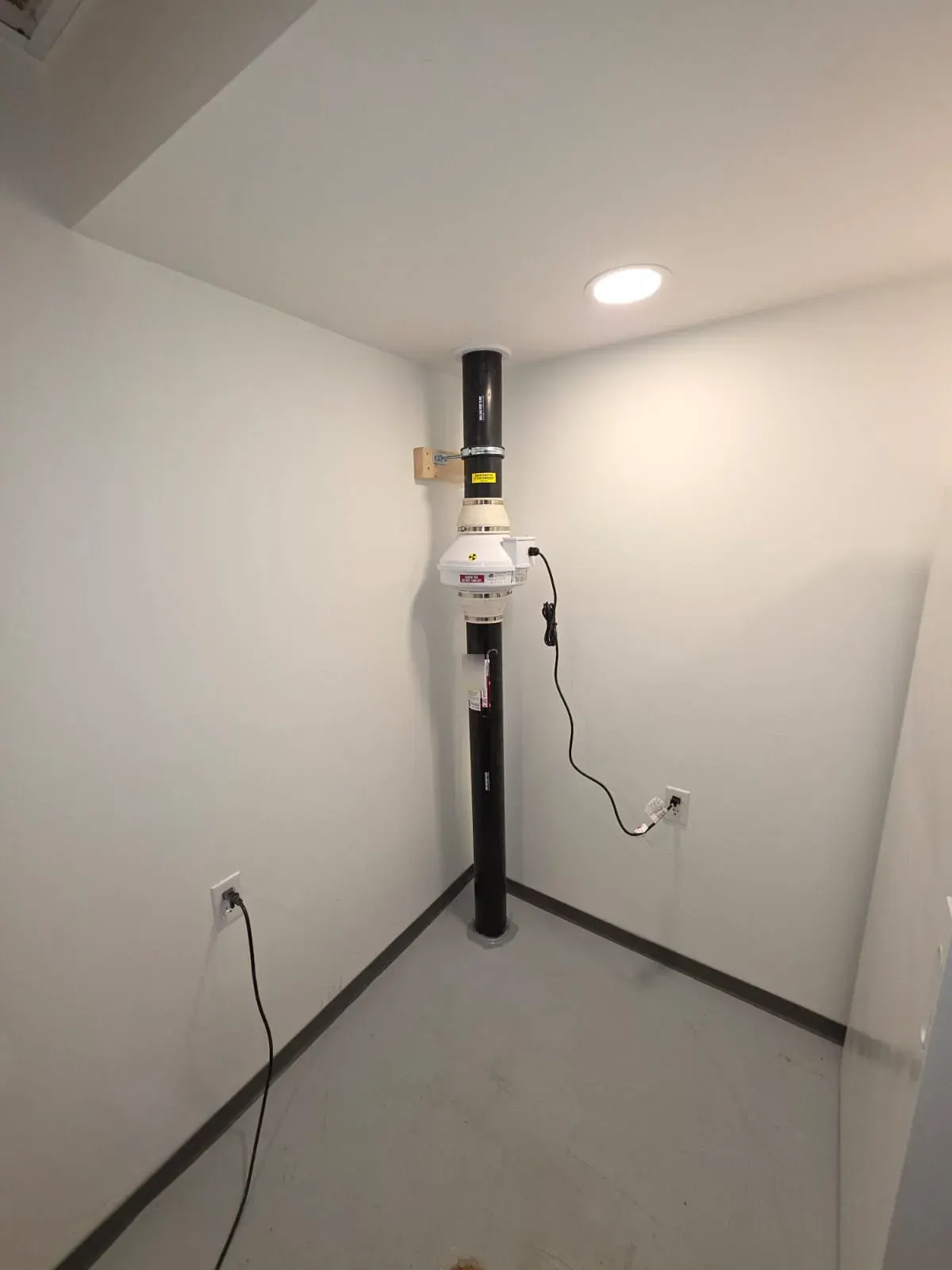
The photo shows a system routed through the corner of a finished basement room, which is the kind of space a suite usually offers. The standard layout keeps the fan on the pipe inside the basement, with the exhaust through the rim joist or side wall and a U-tube manometer below the fan. Health Canada advises owners to hire a professional certified by the Canadian National Radon Proficiency Program (C-NRPP)source. Systems arranged through Calgary Radon Pro are installed by Plinio Neto, whose C-NRPP mitigation credential (CRMT-202966) is held in his own name and listed in the C-NRPP professional directory. The full method is on our page about radon mitigation for Calgary houses, and typical budgets are in the Calgary mitigation cost guide.
Afterwards the system is confirmed like any other. The installer takes a short verification reading. The long-term confirmation uses an independent laboratory kit that the owner places in the suite and mails, so the result does not pass through the installer. See how a system is tested after installation.
A result under the guideline is handled differently. Health Canada's recommendation to act applies above the guideline figure. Below it the decision is the owner's, and no level is considered risk-free, so lower is better.
Share that result too. Keep the report, note the room and the dates, and tell the tenant the number in plain terms. Some owners choose to mitigate at levels under the guideline, especially where a bedroom is in the basement. That is a judgment about a property you own, and the page on radon levels and reference values lays out the figures other agencies use so the choice can be an informed one.
Am I legally required to test or mitigate a rental?
We cannot answer that, because it is a legal question and this site does not give legal advice. What a landlord's obligations are, and whether they extend to radon, is for a lawyer or the provincial authority to say.
What we can describe is the technical position, which is the same in every home. Health Canada recommends testing, it recommends action above the guideline, and a measured result is better than an assumption.
What records should a rental owner keep?
Enough for someone who has never seen the property to follow what was measured and what was done. One folder per address is the simplest system.
| Record | What it should show | When it is useful |
|---|---|---|
| Laboratory test report | The unit, the room, the start and end dates and the result. | Answering a tenant or a future buyer. |
| Placement note | Who placed the detector, and a photo of its position. | Showing the test followed the guide. |
| Tenant communication | What the tenant was told and when the result was shared. | A change of tenant or of property manager. |
| Installation invoice | The installer, the certification number, the date and the fan model. | Any later repair or fan replacement. |
| System label and start-up reading | The installer and date on the label, and the start-up manometer figure if it was recorded. | Checking the gauge at each turnover. |
| Confirmation report | The long-term result after the system was installed. | Showing what the system achieved. |
| Retest reports | Later results, with a note of renovations in between. | Keeping the file current. |
For homes with an active mitigation system, Health Canada recommends a retest every 5 years, and another after any renovation that affects the structure or ventilationsource. In a rental, developing a basement into a suite is one renovation of that kind. A tenant turnover is also a natural moment to glance at the manometer and confirm the fan is running.
What do Calgary landlords need to know about local radon levels?
That elevated results are common enough here to plan for. The Cross-Canada Survey of Radon Exposure found that about 1 in 6 houses in the Calgary area (15.5%) were at or above 200 Bq/m³, and that a further 36.9% were between 100 and 199 Bq/m³source. An owner of several houses may well receive a result that calls for a decision.
Timing matters as well. Health Canada's guide says a test should include at least 91 days of the heating season, when windows are closed and indoor radon tends to be highestsource. The Canadian mitigation standard, quoting Health Canada, gives October to April as the ideal periodsource. A detector set out in autumn and collected in spring can often sit inside one tenancy without touching a move-in or a move-out.
A rental built in recent years may have one advantage. Alberta's building code requires new homes to be provided with the rough-in for a radon extraction system, a capped and labelled pipe through the floorsource. The Canadian standard for new buildings states that a rough-in is not a complete radon control systemsource, so a recent house still needs a test. If that test is high, the pipe can shorten the job, as explained under activating a radon rough-in.
How should I approach several rental properties?
One address at a time on paper, in an order that puts the lowest lived-in levels first. A result from one house says nothing about the next.
Start with the units where people sleep below grade. Follow with houses whose basements are used daily, and leave those with unused basements for last. Give each property its own detector, its own report and its own folder. Where two or more results come back high, deal first with the highest. Health Canada's advice for homes above the guideline is to mitigate sooner the higher the levelsource.
Whether visits to several addresses can be combined, and what that does to the price, depends on the properties and is settled in a written quote. Nothing of that kind is promised on this page. Owners who use a management company can point their manager to our notes on radon for property managers, and the result checker will put any single figure in context.
Frequently asked questions
Should landlords test rental properties for radon?
Health Canada recommends that every home be tested for radon, wherever it is located and whatever the type of building, and a rented house or suite is a home like any other. A tenant has no way to notice radon without a test, so somebody has to decide to run one. In a house with a basement suite, the detector belongs in the suite.
Do I need my tenant's permission to place a detector?
Arrange access by agreement with the tenant. When and how a landlord may enter a rented unit is a legal question, set by the lease and by tenancy law, and we can't advise on it; ask a lawyer or the provincial authority. On the practical side, explain the purpose, agree on placement, and ask the tenant not to move the detector.
Which unit should I test in a house with a basement suite?
The basement suite at minimum, because it's the lowest occupied level. Testing the main floor too gives a picture of the whole house.
What if a tenant's test comes back high?
Thank the tenant, ask what device was used and for how long, and start a long-term laboratory test in the same room. A reading from a consumer monitor or a short test is a reason to run that test, not a basis for mitigation, because Health Canada does not recommend testing for periods shorter than 91 days. If the long-term average is above 200 Bq/m³, Health Canada recommends corrective action.
Are landlords in Alberta required to mitigate radon?
We can't give legal advice, and we don't state what the law requires of a landlord. Whether any obligation applies to radon is a question for a lawyer or the provincial housing authority. The technical advice is the same for every home: Health Canada recommends corrective action when the annual average is above 200 Bq/m³.
Can I mitigate several rental properties at once?
Each property needs its own test and, if the result is high, its own system design, because one house does not predict another. Whether visits to several addresses can be combined, and what that does to the price, depends on the properties and is set out in a written quote. See our page for property managers.
How do I document radon for my rental records?
Keep test reports with dates and placement, system installation details, manometer checks and post-mitigation results.
Sources
- Health Canada, Guide for Radon Measurements in Residential Dwellings (Homes)
- Health Canada, About radon
- Health Canada, Radon: Is it in your home? Information for health professionals
- Health Canada, Radon: What you need to know
- C-NRPP, Consumer-grade electronic radon monitors
- Health Canada, Reducing radon levels in your home
- Cross-Canada Survey of Radon Exposure, Evict Radon National Study (accessed October 2026)
- CAN/CGSB-149.12-2024, Radon mitigation options for existing buildings
- National Building Code – 2023 Alberta Edition, Division B, Sentence 9.13.4.2.(2) and Article 9.13.4.3 (National Research Council of Canada)
- CAN/CGSB-149.11-2024, Radon control options for new buildings
Calgary Radon Pro serves Calgary, Airdrie, Cochrane, Okotoks and Chestermere.
Start with a measurement
Send your details and your latest test result if you have one. We reply by email with the next step for your home.