Radon services for builders
Alberta's building code requires a new home to be given the rough-in for a radon extraction system, not a working system. For a builder, radon therefore comes down to three things: providing the rough-in the code describes, telling the buyer plainly what the capped pipe is, and knowing what happens when a homeowner's long-term test later comes back high. This page explains each part, and where a C-NRPP certified professional fits in.
Request a quote
Tell us about your home. We reply by email with the next step. No obligation.
Prefer email? contact@calgaryradonpro.ca
What does Alberta's code require for radon in a new home?
A rough-in, meaning the provision for a system and not the system itself. Alberta's building code, the National Building Code – 2023 Alberta Edition, in force since May 1, 2024, requires new homes to be provided with the rough-in for a radon extraction system: a capped, labelled pipe through the floor opening into granular material beneath it (Sentence 9.13.4.2.(2) and Article 9.13.4.3)source.
Three words in that description carry weight. In plain terms, capped means the pipe moves no air as built. Labelled means the next person can tell it from a plumbing stub. Granular material is what the pipe opens into beneath the floor. The code text is the authority on the detail, and a builder's own code consultant or the local building authority is the right party to interpret it for a given project. We install and test radon systems. We do not issue code rulings.
Since when has a rough-in been required?
For longer than the current code edition has existed, and the deciding date is the permit application, not the day the house was finished.
Alberta's 2014 building code added protection against soil gas, including radon, for new buildings. It became mandatory at the end of its transition period on November 1, 2015, and a project whose building permit application had been received by then could still be built under the previous codesource. In practice, homes whose building permits were applied for before November 1, 2015 generally were not required to have a radon rough-insource.
That distinction matters when a customer calls about a house from the changeover period. Two homes completed in the same month on the same street may have been permitted under different codes. The possession date in the purchase file does not settle it. The permit record does.
Which standard covers radon control in new construction?
A national standard written for new buildings, separate from the one used on existing houses. The Canadian standard for new construction is CAN/CGSB-149.11-2024, Radon control options for new buildingssource. Its counterpart for buildings that already stand is CAN/CGSB-149.12-2024, Radon mitigation options for existing buildingssource.
Anyone specifying radon measures beyond the code minimum should read the new-construction standard itself and not a summary of it, this page included. How that standard relates to the code on a given project is a question for the builder's code consultant or the local building authority, and we offer no view on it.
Is a rough-in a radon system?
No. It is the starting point for one. The Canadian standard for new buildings states that a rough-in is not a complete radon control system, but allows for easier conversion to one in the future, should it become necessarysource.
This is the sentence most worth repeating to sales staff. A capped pipe has no fan, so nothing is being drawn from under the slab. Describing a new house as ready for a radon system is accurate. Describing it as protected from radon is not something the standard supports. A buyer who hears the second version may skip the test, and the test is the only thing that tells them whether the pipe will ever need a fan.
| Stage | What exists | Who acts | What it means |
|---|---|---|---|
| Construction | The rough-in the code requires: a capped, labelled pipe through the floor. | The builder. | Provision for a system. No radon is being removed. |
| Possession | The same capped pipe, plus whatever the buyer has been told about it. | The builder and the sales team. | The moment to explain the pipe and recommend a test. |
| Heating season after move-in | A long-term detector on the lowest lived-in level. | The homeowner. | The first real measurement of the house as it is lived in. |
| Result above the guideline | A decision to activate the rough-in. | The homeowner, with a certified mitigation professional. | A fan, a manometer and an exhaust are added to the pipe. |
| After activation | A short verification reading, then a long-term laboratory test. | The installer, then the homeowner. | A measurement of what the working system achieved. |
What should a buyer be told at possession?
What the pipe is, what it is not, and that the house should be tested once they live in it. A few lines in the homeowner manual and one sentence at the walkthrough are enough.
The points worth putting in writing are these:
- where the radon pipe is, and that its cap and label should stay in place;
- that the pipe is a provision for a future system and does nothing while capped;
- that it should stay reachable if the basement is developed, and not be sealed behind a wall with no access;
- that the only way to learn the home's radon level is a long-term test;
- that the test is the owner's to run, and where to find the instructions.
Health Canada's recommendation is that every home be tested for radon, regardless of where it is located or what type of building it issource. A new house is not an exception. Its advice for buyers is to conduct a long-term radon test once they have moved into their new homesource. Passing that advice on in those words is the simplest useful thing a builder can do.
Who tests the home after occupancy?
The homeowner, with a long-term kit from an independent laboratory. The test belongs to the people living in the house, and so does the report.
Health Canada recommends measuring for 3 to 12 months, and no less than 91 dayssource. At least 91 days of that period should fall in the heating season, when windows are closed and indoor radon tends to be highestsource. A family that takes possession in summer therefore starts the test in autumn. One that moves in during winter can start at once.
A quick test at the time of sale is not a substitute. Health Canada does not recommend conducting a radon test during a real estate transaction, because a three-month test is the only way to accurately find out the radon level in a homesource. An empty house that has just been finished, with trades coming and going and nobody living in it, is also a poor stand-in for the home it will become.
A builder who wants to make the test easy can hand over a long-term kit, or simply the instructions, with the keys. The method is on our page about long-term radon testing in Calgary and in the step-by-step guide to testing for radon.
What happens when a new home tests above the guideline?
The rough-in is activated. A fan and the parts that go with it are added to the pipe the builder left, and the capped stub becomes a working system.
The Canadian guideline for radon in indoor air is 200 Bq/m³, and Health Canada recommends corrective action when the annual average is above itsource. Above that level it recommends mitigating within one year, and sooner the higher the levelsource. That recommendation applies above the guideline. Below it the decision is the owner's, given that no level is considered risk-free and lower is better.
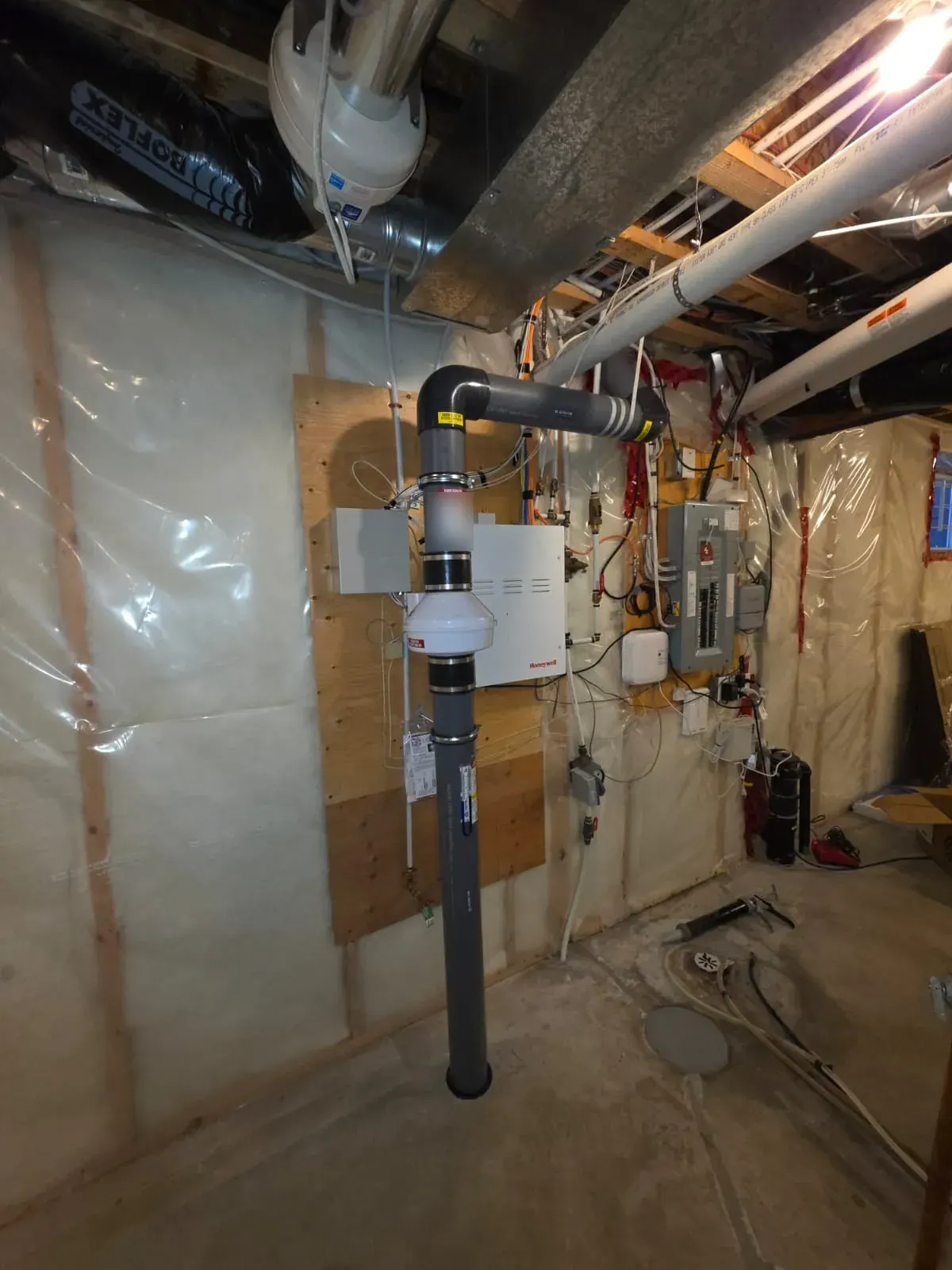
The drawing shows an activated rough-in as Plinio Neto lays one out. The fan sits on the pipe inside the basement, the exhaust leaves through the rim joist or side wall, and a U-tube manometer is fixed to the pipe below the fan. In some houses the exhaust goes above the roof by a route inside the building. The photo shows a system of this type in an unfinished basement.
Health Canada calls sub-slab depressurization the most common and effective methodsource. An activated rough-in works on that principle. Under the Canadian mitigation standard a system may discharge above the roof or through a side wall near ground level, with side-wall discharge to be favoured in cold weather areassource. A U-tube manometer on the pipe then indicates that the system is working, the higher liquid level on one side showing the pressure difference created by the fansource. Health Canada reports that a radon reduction system reduces radon by more than 80% in most homessource. No particular figure can be promised for a particular house.
The work is described step by step under radon rough-in activation in Calgary. It usually starts from the homeowner's own test.
Can rough-ins be activated across several homes at once?
Each activation is decided house by house, because each house has its own result. Radon levels vary from one house to another, even between similar houses next door to each other, and the only way to be sure of a home's level is to testsource.
Identical floor plans on adjoining lots can therefore produce very different numbers, and a high result at one address is no reason to assume the same of the rest. A builder who chooses to activate rough-ins before sale, as a feature, is making a different decision, and it is a legitimate one. In that case, ask us whether we can take the work on. Each home would still need its own long-term test once it is occupied.
Whether several homes in a development can be booked together, and at what price, depends on the project. Those terms belong in a written quote. This page promises none of them.
Why are new homes in Calgary a radon question at all?
Because the research, local and national, points at newer houses and not older ones. In the 2017 southern Alberta study, homes built in 1992 or later averaged 31.5% more radon than older homes (142 versus 108 Bq/m³)source. A 2021 study found that Canadian houses built in the 2010s and 2020s averaged 131 Bq/m³, against 28 Bq/m³ for Swedish houses of the same periodsource.
Research led by the University of Calgary found that radon in new Canadian houses has been rising since about 1980source. Across all ages of housing the local picture is this: the Cross-Canada Survey of Radon Exposure found about 1 in 6 houses in the Calgary area (15.5%) at or above 200 Bq/m³source.
None of this is a criticism of how any one company builds. The studies describe averages across thousands of homes, and they do not rank builders. What they do show is that a new address in Calgary is no assurance of a low reading. That is the reason the buyer's test matters. The wider evidence is summarised in our review of radon research on Calgary homes.
What paperwork should exist for each home?
Enough for a homeowner, and later a second owner, to see what was provided, what was measured and what was installed. The list is short.
| Document | Who produces it | What it should contain |
|---|---|---|
| Rough-in note in the homeowner manual | The builder. | Where the pipe is, what it is for, and the advice to test after moving in. |
| Long-term test report | An independent laboratory, for the homeowner. | The room, the start and end dates and the result. |
| Activation invoice | The installer. | The date, the fan model, and the name and certification number of the person who did the work. |
| System label | The installer. | Who installed the system and the date. |
| Confirmation test report | An independent laboratory, for the homeowner. | The long-term result with the system running. |
The confirmation follows the same rule as on any other job. The installer takes a short verification reading after activation. The long-term result comes from an independent laboratory kit that the homeowner places and mails. Health Canada recommends testing again after a system is installed, and retesting homes with active mitigation systems every 5 yearssource. The procedure is laid out under post-mitigation testing for Calgary homes.
Who does the radon work, and how can a builder check?
A named, certified individual, whose certification anyone can look up. The professional Health Canada recommends hiring is one certified by the Canadian National Radon Proficiency Program (C-NRPP)source. C-NRPP offers a public search tool to find certified professionals, and a certification check that confirms an individual's certification from the certification numbersource.
Work arranged through Calgary Radon Pro is done by Plinio Neto. He holds the C-NRPP Radon Mitigation Professional certification (CRMT-202966) and the C-NRPP Radon Measurement Professional certification (CRT-202965). Both belong to him as a person, not to a company, and both appear in the C-NRPP directory. A builder passing a name to a homeowner can check it there first.
For a homeowner with a result in hand, the radon test result checker and the page on radon levels and the Canadian guideline are the quickest explanations. Our Calgary cost guide for radon mitigation covers budgets, and the main radon mitigation page covers how systems are designed. Our guide on choosing a radon contractor is written for homeowners, and it is equally useful to a builder deciding who to recommend.
Frequently asked questions
What does Alberta's code require for radon in new homes?
The National Building Code – 2023 Alberta Edition, in force since May 1, 2024, requires a radon rough-in with a capped pipe. The code describes a capped pipe, not a working system.
Which Canadian standard covers radon control in new construction?
CAN/CGSB-149.11-2024 sets out radon control options for new buildings.
Can you test homes after occupancy for a builder?
The test after occupancy belongs to the homeowner. Health Canada's advice for buyers is to conduct a long-term radon test once they have moved in. It is done with an independent laboratory kit that the homeowner places and mails, and the report goes to them. A builder can supply the instructions at possession.
Can rough-ins be activated across a development?
A rough-in is activated one house at a time, because each home has its own soil, slab and test result. Whether several homes in a development can be booked together, and at what price, depends on the project and is settled in a written quote. No volume pricing is promised here.
What makes a rough-in effective?
The code describes what must be provided: a capped, labelled pipe through the floor that opens into granular material beneath it. The Canadian standard for new buildings adds that a rough-in is not a complete radon control system. How well it performs is shown only by a radon test once a fan has been added.
Do you provide documentation for buyers?
A properly documented activation leaves the homeowner with the invoice, the name and certification number of the installer, the fan model, and a label naming the installer and the date. The long-term confirmation report comes from an independent laboratory and is addressed to the homeowner. What a given project includes is confirmed in the quote.
Sources
- National Building Code – 2023 Alberta Edition, Division B, Sentence 9.13.4.2.(2) and Article 9.13.4.3 (National Research Council of Canada)
- Alberta Municipal Affairs, Notice: New Alberta Building, Fire and Energy Codes (April 29, 2016)
- CAN/CGSB-149.11-2024, Radon control options for new buildings
- CAN/CGSB-149.12-2024, Radon mitigation options for existing buildings
- Health Canada, Guide for Radon Measurements in Residential Dwellings (Homes)
- Health Canada, Radon in real estate
- Health Canada, Reducing radon levels in your home
- Health Canada, About radon
- Stanley et al., Comprehensive survey of household radon gas levels and risk factors in southern Alberta, CMAJ Open, 2017
- Khan et al., Scientific Reports, 2021
- University of Calgary News, 2021
- Cross-Canada Survey of Radon Exposure, Evict Radon National Study (accessed October 2026)
- C-NRPP, Find a Professional and Certification Check
Calgary Radon Pro serves Calgary, Airdrie, Cochrane, Okotoks and Chestermere.
Start with a measurement
Send your details and your latest test result if you have one. We reply by email with the next step for your home.