Radon fan replacement in Calgary
The fan is the one moving part of a radon mitigation system, and when it stops the system stops with it. The usual signs are a manometer whose two liquid columns have gone level, a change in the sound the fan makes, or an alarm. Replacement means fitting a fan that matches the suction and airflow the house needs, checking the gauge against the original reading, and then testing the air again to confirm the level has come back down.
Request a quote
Tell us about your home. We reply by email with the next step. No obligation.
Prefer email? contact@calgaryradonpro.ca
What does the fan do in a radon system?
It creates the pressure difference that the whole method relies on. Without it, the pipe through the floor is only a pipe.
Health Canada describes sub-slab depressurization as the most common and effective way of reducing radon, and gives sealing or added ventilation only a limited effect by themselvessource. The word that matters is depressurization. A fan on the pipe draws air from the soil under the slab, a sump lid or a crawl space membrane, and sends it outdoors. That keeps the ground side at a lower pressure than the basement, so soil gas travels to the pipe and not into the room.
The fan runs day and night, in every season, for as long as the house stands on that soil. It is the only component with a motor and bearings, so it is the part that eventually needs attention. Some people call it a radon pump. It is the same device.
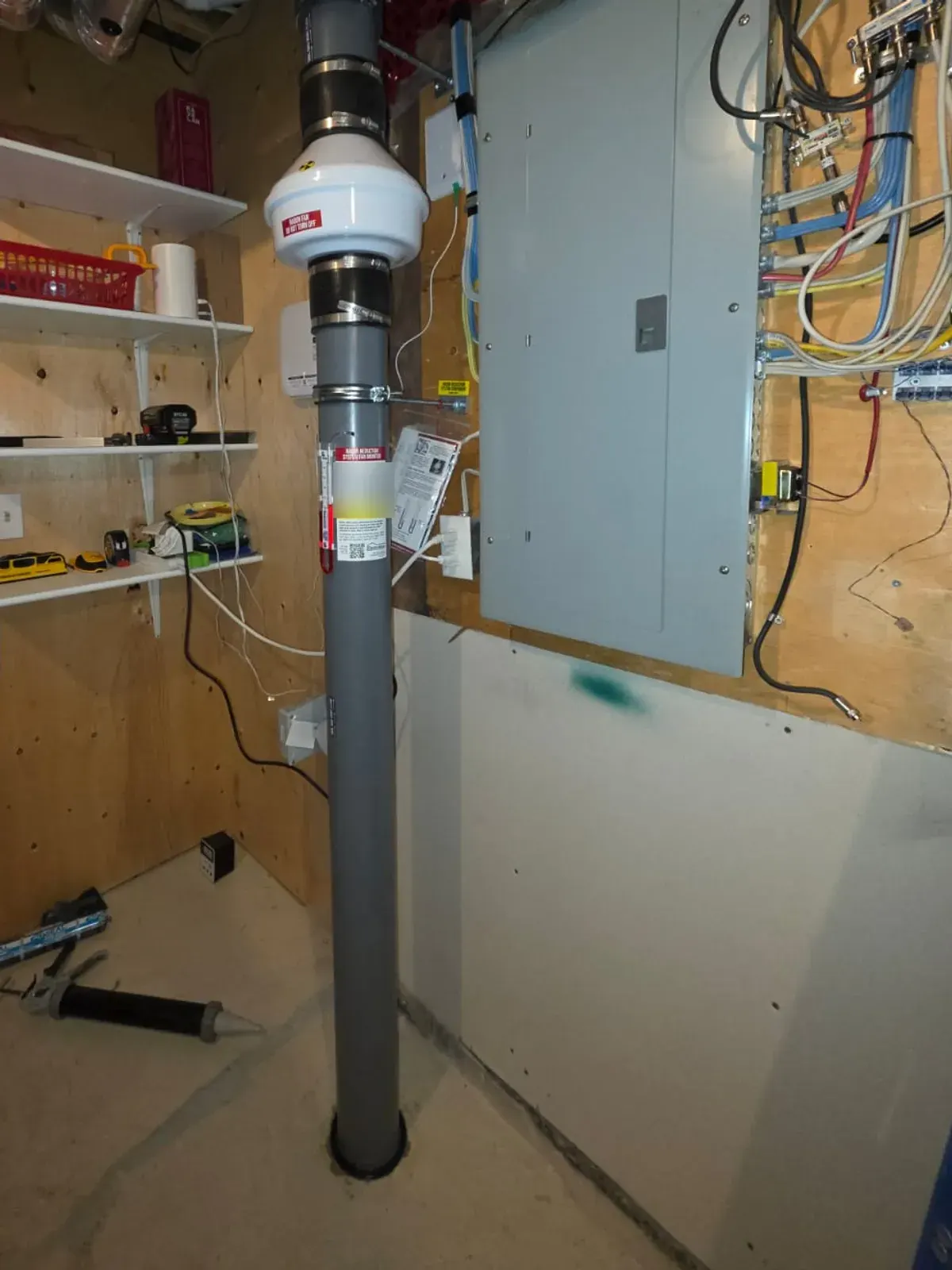
The drawing shows the layout Plinio Neto installs as standard, with the fan on the pipe inside the basement and the manometer below it. The photo shows a fan of that kind mounted beside an electrical panel. A fan placed indoors like this is easy to hear, easy to reach and easy to swap.
What are the signs that a radon fan is failing?
A changed gauge, a changed sound, an alarm or a rising reading on a monitor. One of these on its own is a reason to look closer. It is not yet proof that the fan is finished.
| What you notice | What it may mean | First check |
|---|---|---|
| Both columns of the manometer at the same height | No suction in the pipe: the fan is off, seized or disconnected. | Breaker, switch and plug, then listen at the fan housing. |
| Manometer difference smaller than the figure on the label | Less suction than at start-up: a tired motor or a new air leak. | Couplings at the fan, the sump lid and any seals that were disturbed. |
| Manometer difference larger than the figure on the label | The fan is pulling against a restriction. | The outlet outside, and whether water is sitting in a low section of pipe. |
| Humming with no vibration of moving air | The motor has power but the impeller is not turning. | Switch it off and book a visit; do not leave it humming. |
| Grinding, rattling or a rising whine | Worn bearings, or something loose against the housing. | Whether the sound comes from the fan itself or from a pipe touching framing. |
| Alarm light or tone on the pipe | The pressure switch has detected a loss of suction. | The manometer, to confirm what the alarm is reporting. |
| Electronic monitor trending upward | The system is moving less soil gas than before. | The gauge first, then how the reading compares with the same season a year earlier. |
Sound deserves its own note. Every fan makes some, and the level you heard on installation day is the baseline. What counts is a change. Our guide to radon fan noise and what causes it separates the harmless sounds from those that point to the motor.
How do I read the manometer?
Compare the two liquid levels with each other, and then with the figure written on the label. A U-tube manometer on the pipe indicates that the system is working when the liquid stands higher on one side, which reflects the pressure difference the fan createssource.
The installer normally marks the start-up reading on the tube or on the system label. That number belongs to your house. A neighbour's gauge may sit higher or lower and be perfectly normal, because the soil and the fan are different. What you are watching for is movement away from your own mark.
Two limits are worth knowing. First, the gauge is not a radon meter. It shows suction in the pipe and nothing about the air in the room. Second, the gauge can mislead when the small tube that links it to the pipe has slipped off or the liquid has evaporated low. A level gauge with a fan that is clearly running and moving air usually means the tube, not the motor. More detail is in our guide to the manometer and alarm.
What can I check myself before booking a visit?
Power, the outlet and the gauge tube. These are the simple causes of a silent fan, and none of them needs tools.
- Look at the electrical panel for a tripped breaker, and reset it once only.
- Find the switch or plug near the fan. Fans are sometimes switched off by a tradesperson or unplugged to free an outlet.
- Put a hand on the pipe beside the fan. A running fan gives a faint, steady vibration.
- Go outside and look at the exhaust opening. Snow piled against the wall, leaves, a nest or a child's toy can block it.
- Check that the manometer tube is still pushed into the pipe at one end and the gauge at the other.
- Note the gauge reading and the fan's model label, and take a photo of both.
Stop there. A breaker that trips again points to an electrical fault in the motor, and the fan should stay off until it has been looked at. Do not open the fan housing or loosen the couplings while the system is under suction. The photo of the label and gauge is useful: it lets the installer arrive with a suitable fan.
Is the problem the fan or the rest of the system?
Often the fan, but not always. A healthy motor cannot hold suction if air is leaking in somewhere else, and a new fan will not fix a leak.
| Finding at the visit | Fan or system | Usual repair |
|---|---|---|
| Motor seized, burnt out or drawing no current | Fan | Replace the fan with a matched model. |
| Bearings noisy but suction still normal | Fan | Replace at a convenient time before it stops. |
| Rubber coupling cracked or slipped off the pipe | System | Refit or replace the coupling and recheck suction. |
| Sump lid left unsealed after pump service | System | Reseal the lid and its cable and pipe grommets. |
| New cracks or a cut in the slab after renovation | System | Seal the opening; test whether suction still reaches the whole floor. |
| Gauge tube detached or liquid low | System | Reconnect the tube or refill the gauge. |
| Fan sound and suction normal, radon still high | System design | Diagnostic testing, then an added suction point or a different fan. |
That last row is the one a simple swap cannot solve. If the level was never brought down properly, the fault lies in the design and not in the age of the motor. Work of that kind is described under radon system inspection and repair.
How is the replacement fan chosen?
By matching it to the house, not by picking the strongest one on the shelf. Fans differ in how much suction they can develop and how much air they can move, and those two abilities trade off against each other.
The ground under the floor decides which matters more. Coarse gravel lets air through easily, so the fan has to move volume without needing much suction. Dense clay or sand gives up very little air, so the fan must pull hard to move a small amount. A fan built for the first job performs poorly at the second, and the reverse is also true.
When the old system worked well, the starting point is the model on the old fan's label and the reading on the gauge. A like-for-like replacement usually restores the original performance. When the old system was marginal, the installer measures suction at the pipe and at test points in the slab before choosing, and may recommend a different model. Pipe diameter, the length of the run and the number of bends are part of the same calculation, since each adds resistance the fan has to overcome.
Manufacturers publish their own terms of coverage for each model. Keep the invoice and the model number, and read the manufacturer's document for what it says. We do not restate those terms here.
What happens during the replacement visit?
The old fan comes out between its two couplings and the new one goes into the same space. In the standard indoor layout no pipe has to be cut.
- Diagnosis. Power, gauge and airflow are checked to confirm the fan is the cause.
- Isolation. The circuit is switched off and the fan is disconnected.
- Removal. The couplings are loosened and the fan is lifted out; any water in the housing is drained.
- Inspection. The pipe on both sides, the outlet and nearby seals are examined while the system is open.
- Fitting. The new fan is set in the correct direction of flow and the couplings are tightened.
- Start-up. Power is restored and the manometer is read against the original mark.
- Record. The label is updated with the new model, the date and the new reading.
Health Canada recommends that radon work be done by a professional certified through the Canadian National Radon Proficiency Program (C-NRPP)source. Fan replacements arranged through Calgary Radon Pro are done by Plinio Neto, C-NRPP certified mitigation professional (CRMT-202966). The credential is personal to him and is listed in the C-NRPP online directory. The standard behind the work is CAN/CGSB-149.12-2024, the Canadian document on radon mitigation options for existing buildingssource. It does not matter who installed the original system.
What goes into the price of a fan replacement?
The fan itself, the labour to exchange it and the check afterwards. The fan model is the largest variable, followed by how easy the old one is to reach.
A fan in a basement mechanical room is quick to change. One mounted in an attic, or high on an outside wall, takes longer because of access. Extra work found during the visit, such as a failed coupling, a section of pipe that holds water or a missing gauge, should be priced and explained before it is done. Our Calgary mitigation cost guide shows how a fan replacement compares with a new system.
How urgent is a stopped fan?
It is not an emergency, and it should not be left for a season either. With the fan off, expect the radon level to drift back toward what the house measured before the system existed.
Health Canada lists an increased risk of lung cancer as the only known health effect of radon, and describes that risk as long-term, not immediate, depending on the level, the length of exposure and smokingsource. That is why the concern with a stopped fan is the weeks and months it stays off, and why a long interruption is worth avoiding, above all in a house that tested far above the guideline to begin with. For homes above 200 Bq/m³, Health Canada's advice is to mitigate within one year, and sooner when the level is highersource. A house whose system has quit is, in practice, back in that position.
So book the visit, and resist the urge to open windows in January as a substitute. If you have the original test report, find it. The pre-mitigation number tells you how much the fan was doing.
Why does a stopped fan matter more in a Calgary winter?
Because the cold months are when houses here pull hardest on the soil. Health Canada notes that radon is drawn in where indoor air pressure is lower than the pressure in the ground, and that the stack effect increases entry during cold monthssource. It also describes the heating season, with windows closed, as the time when indoor radon tends to be highestsource. A fan that fails in November therefore leaves the system off through the months when indoor radon tends to be highest.
The standard layout helps with access in that season. The Canadian mitigation standard allows a system to vent above the roof or through a side wall near ground level, and says the side-wall arrangement shall be favoured in cold weather areassource. With the fan indoors and only the outlet outside, a replacement is a job done standing on a basement floor, whatever the weather. Systems built by other installers with the fan in an attic or on an exterior wall can be serviced too. The visit takes longer, and the assessment may raise the option of moving the fan inside.
Winter is also when the outlet most needs a glance. After heavy snowfall or drifting, walk round to the side of the house and make sure the opening is clear.
How is the new fan's performance confirmed?
In two stages: suction on the day, radon afterwards. The manometer reading at start-up shows the fan is pulling as it should. Only a measurement of the air shows what that has done to the level.
The installer takes a short verification reading once the new fan has been running. A consumer monitor of your own, if you keep one, can follow the trend after that. C-NRPP tests consumer-grade electronic radon monitors and publishes the models it approves; it points out that they cannot be professionally calibrated, and advises leaving one in place for at least 3 monthssource. Treat a monitor as a trend indicator, not as the record for the house.
The record comes from a long-term test, done with an independent laboratory kit that you place and mail yourself. We do not grade our own work. Health Canada recommends a measurement lasting 3 to 12 months and no shorter than 91 dayssource. It also recommends retesting a home with an active system every 5 years, and after renovations that affect the structure or ventilationsource. In our view a fan change is a sensible moment to restart that clock. The figure is then read against the Canadian guideline of 200 Bq/m³, the annual average above which Health Canada recommends corrective actionsource, keeping in mind that lower is better and no level is considered risk-free.
The procedure is set out under post-mitigation radon testing. To understand a number you already have, use the test result checker or read radon levels and what the guideline means. For everything else about how these systems are designed, start at radon mitigation for Calgary homes, or see rough-in activation in newer houses and sump pit mitigation systems for the two closest services.
Frequently asked questions
How long does a radon fan last?
Radon fans are designed for continuous operation. Health Canada's Radon Reduction Guide for Canadians (2014) says the lifespan of a radon fan can vary between five and ten or more years. Manufacturer warranties vary. The manometer is your early warning: when suction drops, check the fan.
How do I know my radon fan has failed?
The manometer shows equal liquid levels, the fan is silent or hot to the touch, an alarm sounds or shows a light, or a radon monitor shows levels climbing back up. Check the circuit or switch first, since a tripped breaker is a common cause.
Why is my radon fan suddenly louder?
Noise often comes from worn bearings, vibration transferring into framing, ice or water in the pipe, or the fan working harder against a blockage. Some noise is normal, but a change in sound deserves a check. Our guide to radon fan noise explains the common causes.
Can I replace a radon fan myself?
It is possible, but it involves electrical work and a sealed connection under suction, so it is a job we would leave to a certified professional. A replacement should match the system's design airflow and pressure; the wrong fan can underperform or waste energy. After any replacement, retest.
Does a bigger fan work better?
Not necessarily. The right fan matches the soil, slab and pipe system. Too small and suction is weak; too large and it pulls excess indoor air, raising energy use and sometimes noise, without lowering radon further. Fan selection is part of the design.
Do radon fans freeze in Calgary winters?
They can when the fan and pipe sit outside the heated part of the house. Health Canada's Radon Reduction Guide for Canadians (2014) says a fan and pipe in that position cool in the colder months, which can lead to condensation and possibly ice that damage the fan and reduce effectiveness. The same guide says placing the fan indoors with a short discharge near ground level reduces the problem. Repeated freezing is a design issue worth raising when the fan is replaced.
Should I retest after replacing the fan?
Yes. The installer takes a short verification reading once the new fan is running, and a long-term test in the next heating season, done with an independent laboratory kit that you place and mail, confirms the result.
Sources
- Health Canada, Reducing radon levels in your home
- CAN/CGSB-149.12-2024, Radon mitigation options for existing buildings
- Health Canada, Radon: Is it in your home? Information for health professionals
- Health Canada, Guide for Radon Measurements in Residential Dwellings (Homes)
- Health Canada, About radon
- C-NRPP, Consumer-grade electronic radon monitors
- Health Canada, Radon Reduction Guide for Canadians, 2014
Calgary Radon Pro serves Calgary, Airdrie, Cochrane, Okotoks and Chestermere.
Start with a measurement
Send your details and your latest test result if you have one. We reply by email with the next step for your home.